
The short answer: careers requiring physical presence, human relationships, ethical judgment, and creative intuition are the safest from AI. The World Economic Forum's Future of Jobs Report 2025 projects a net gain of 78 million jobs by 2030 — but only for people entering the right fields with the right skills. Mental health counselling, skilled trades, surgery, special education, civil engineering, social work, and AI governance are among the careers with the lowest risk of automation. The question isn't just which field — it's whether your personality and aptitude are wired for it. That distinction is where most career advice fails you.
The fear is real. Every week, a new headline announces another category of jobs being disrupted by AI. Students choosing their Class 11 stream are making decisions whose consequences will play out across a 40-year career — in a job market that looks nothing like the one their parents navigated.
But the fear is also, in important ways, imprecise. The data does not support the narrative that AI will erase work. It supports a more nuanced story: AI is redistributing work — away from routine, rule-based tasks and toward roles that require what only humans can reliably do.
The WEF's numbers in full: By 2030, 170 million new jobs will be created globally while 92 million are displaced — a net gain of 78 million jobs. But the report is explicit: those jobs go to workers who build the right skills. The 39% of skills considered valuable today will be transformed or obsolete by 2026. Analytical thinking and AI fluency are the top two most valued skills by 2030. And 63 out of every 100 workers will require significant retraining (WEF, Future of Jobs Report 2025).
For Indian students specifically, this is both a warning and a window. India's demographic dividend — the world's largest youth population entering the workforce — is either its greatest advantage or its greatest liability, depending entirely on whether students enter careers that are growing or contracting. Two-thirds of companies operating in India already see a need to tap into more diverse talent pools to fill roles that simply cannot be automated, according to the same WEF report — far above the global average of 47%.
This blog cuts through the noise. Below is the data, the career categories, and — critically — the psychometric logic behind why career-fit matters as much as career-choice when the goal is long-term resilience.
Before you read further — a question worth sitting with: Do you actually know which of your qualities AI cannot replicate? Not in theory. In data.
Lyfe Path's 6-dimension psychometric assessment maps your RIASEC profile, Big Five personality, aptitude scores, motivators, learning style, and personality type — then connects the results to career outcomes and job market resilience. It's the most specific answer you can get to the question this blog is trying to answer. Take the assessment here.
Most research on AI and jobs makes predictions. Microsoft did something different. In 2024, their research team analysed nine months of real conversations between 200,000 anonymised users and Bing Copilot — the largest real-world study ever conducted on how AI actually affects different professions in practice, not in theory.
The methodology matters. Rather than modelling what AI could theoretically do, the study measured what tasks people were actually getting AI to help with — and which tasks AI demonstrably could not complete. The result was what they called an "AI applicability score": a measure of how much overlap exists between AI capabilities and the daily tasks of a given profession.
Highest AI applicability scores (most disrupted): Interpreters and translators, historians, passenger attendants, customer service representatives, writers producing templated content, telephone operators, and CNC programmers.
Lowest AI applicability scores (safest): Roles requiring physical presence in unpredictable environments, direct human therapeutic contact, ethical judgment under uncertainty, and creative direction requiring cultural intuition.
Critical finding: Microsoft's lead researcher Kiran Tomlinson stated clearly: "Our research shows that AI supports many tasks, particularly those involving research, writing and communication, but it does not indicate it can fully perform any single occupation." No job is fully automatable. But many are significantly disrupted at the task level.
The practical implication for students: it is not enough to choose a "safe" profession. You need to understand which tasks within your chosen profession AI will absorb — and ensure your competitive advantage lies in the tasks it cannot touch.
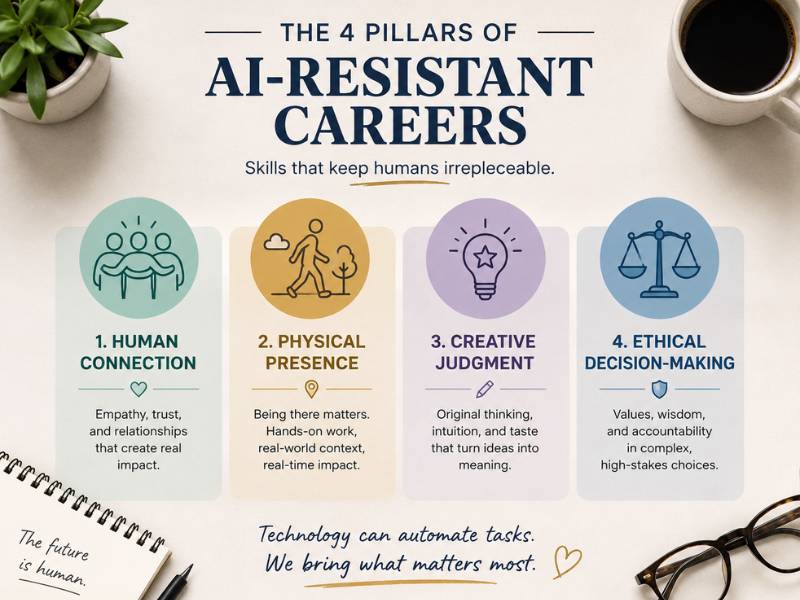
The four pillars of AI-resistant careers, based on Microsoft Research and WEF 2025 data
Across all major research — WEF, Microsoft, McKinsey, OECD, and OpenAI/University of Pennsylvania — four qualities consistently define the careers AI cannot replace. Roles that score high on all four show 85–98% AI-resilience scores, according to analysis by PrometAI (2026).
In some careers, the relationship between practitioner and client is not a means to an end — it is the end. Psychotherapy works because a trained human being bears witness, asks the right question at the right moment, and sits with discomfort without flinching. The same is true of palliative care, social work, career counselling, and special education. You cannot outsource the therapeutic relationship to an algorithm, because the relationship is the intervention. No AI can replicate the specific quality of being seen by another human being who chooses to understand you.
Robotics has made extraordinary advances. But robots operating in chaotic, variable, real-world environments — a live construction site, a surgical theatre, the electrical grid, an intensive care unit — remain far behind human dexterity and situational judgment. A plumber diagnosing a leak behind a wall in a 40-year-old building is solving a novel physical puzzle that no training dataset fully anticipated. Skilled trades, surgery, and physical infrastructure roles remain structurally resistant to automation for precisely this reason.
AI systems optimise for defined outcomes. They cannot hold competing moral obligations in tension, weigh community values against individual rights, or take responsibility for a decision that will affect a human life. Judges, senior doctors, AI governance specialists, social workers making child protection decisions, and leaders navigating crisis — these roles require moral agency. Gartner projects that 75% of large organisations will have dedicated AI governance teams by 2026, creating an entirely new category of high-value, high-resilience employment.
AI can generate content at scale. It cannot generate genuine cultural insight, original artistic vision rooted in lived experience, or the kind of creative direction that comes from understanding a specific community from the inside. Senior creative directors, cultural strategists, architects designing for specific communities, and writers doing original investigative journalism occupy territory AI can approximate but never authentically occupy.

Healthcare, trades, engineering, and therapy: the career clusters with the highest AI resilience scores
This is the most robust AI-resistant cluster in the entire job market. Nurse practitioners are projected to grow 52% from 2023 to 2033 (US Bureau of Labor Statistics) — and India's rapidly expanding healthcare infrastructure mirrors this trend domestically. Psychologists, psychiatrists, occupational therapists, physiotherapists, and speech-language pathologists all involve direct physical or therapeutic human contact that AI cannot replicate.
Importantly: AI will transform diagnostics, imaging, and administrative work within healthcare. The students who will thrive are those entering healthcare for the human-contact dimensions — not the data-processing ones.
This is the most underrated AI-resistant career cluster among Indian students and families. Electricians, plumbers, HVAC technicians, construction supervisors, and civil engineers working on physical infrastructure consistently score among the lowest on AI applicability. Civil engineers show projected growth of 6.9% through 2033, with specialised roles in sustainable infrastructure showing stronger growth (Wealthwaggle analysis, 2025). In India, the acute shortage of formally certified skilled tradespeople makes this career cluster both resilient and significantly under-supplied.
While routine instructional content delivery will be increasingly AI-assisted, special education teachers, early childhood educators, and school counsellors occupy roles built on human attunement that no platform can replicate. A teacher who notices that a child is struggling not with the concept but with something happening at home — and knows exactly how to respond — is performing a function that requires years of human development to build. These roles are not glamorous. They are irreplaceable.
Basic legal research is already being automated. Routine contract review and document drafting are highly vulnerable. But litigation, criminal defence, family law, constitutional law, and senior advisory roles require judgment, advocacy, and ethical navigation under uncertainty that AI cannot replicate. The legal career that is safe from AI is the one focused on human advocacy and complex judgment — not the one focused on information retrieval.
This is the fastest-emerging AI-resistant category — and the one least on the radar of Indian students and families. As AI systems are deployed in medicine, law, finance, and government, the demand for humans who understand both the technical capabilities and the ethical implications is exploding. Gartner's projection that 75% of large organisations will have dedicated AI governance teams by 2026 represents an entirely new employment category that barely existed five years ago.
Entry-level content creation, templated writing, and basic design work are highly vulnerable. But the people who direct creative vision — who decide what a brand stands for, what story a film needs to tell, what a building should mean to the community it serves — operate in territory AI cannot authentically occupy. The career path that leads to creative direction is longer and less linear than it used to be. The destination remains secure.
| Career Category | AI Resilience | Key Pillar | India Growth Outlook |
|---|---|---|---|
| Mental Health / Therapy | Very High | Human relationship as intervention | Strong — infrastructure rapidly expanding |
| Surgery / Clinical Medicine | High | Physical dexterity + ethical judgment | Strong — 52% nurse practitioner growth (US proxy) |
| Skilled Trades | Very High | Physical dexterity in unpredictable environments | Very strong — acute shortage of certified tradespeople |
| Special / Early Childhood Education | Very High | Human attunement and relationship | Moderate to strong — underserved sector |
| Civil Engineering (Infrastructure) | High | Physical + systems judgment | Strong — 6.9% projected growth through 2033 |
| AI Governance / Ethics | Very High | Ethical judgment + technical literacy | Emerging and fast-growing — new category |
| Senior Creative Direction | High | Cultural intuition + original vision | Moderate — long path, secure destination |
| Litigation / Complex Legal Work | Moderate-High | Ethical judgment + advocacy | Moderate — routine legal work disrupted |
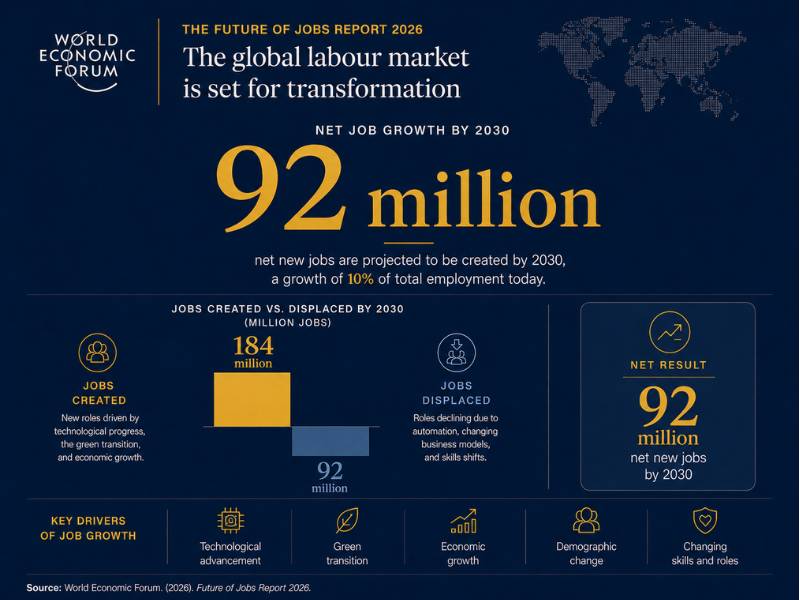
WEF Future of Jobs Report 2025: 170 million new jobs created, 92 million displaced, net gain of 78 million by 2030
Here is the part that most career advice articles skip entirely. They give you a list. They do not give you a method for matching the list to the person standing in front of you.
The honest answer to "which careers are safe from AI?" is: the ones that align with your specific human qualities that AI cannot replicate. And the only way to identify those qualities precisely is through psychometric assessment — not gut feeling, not parental expectation, not peer pressure.
Consider what the data actually measures:
RIASEC profile: A strongly Social type is built for human-contact roles — therapy, counselling, education, social work. A Realistic type with strong spatial reasoning is built for skilled trades and physical engineering. An Investigative-Artistic type belongs in creative direction or research. These are not preferences. They are structural tendencies that predict sustained engagement and performance over a 20-year career.
Big Five personality: High Agreeableness combined with high Openness predicts performance and fulfilment in therapeutic and educational roles. High Conscientiousness with low Neuroticism predicts resilience in surgery and high-stakes clinical work. These traits do not change significantly after early adulthood — and they are precisely what AI cannot replicate, because they are the bedrock of human relationship quality.
Aptitude scores: Above-average verbal reasoning and emotional pattern recognition predict success in counselling and advocacy. Strong spatial and mechanical aptitude predicts success in trades and physical engineering. Aptitude is not intelligence — it is the specific shape of what your mind does naturally and efficiently.
Motivators: A student whose primary motivators are meaning and human connection — not financial security or structure — will build a sustainable, fulfilling career in the human-centred roles that AI cannot touch. A student motivated primarily by security and structure may struggle in those same roles despite having the aptitude for them. Motivator alignment is the difference between a career that sustains you and one that depletes you.
A mother called me in a panic last year. Her son Arjun had just received his Class 12 results — solid marks, no engineering seat, no clear plan — and she had been reading articles about AI replacing doctors, lawyers, accountants. "Tell me one career," she said, "where he won't become obsolete by the time he's 30."
I asked Arjun to take the assessment before we talked further. When his results came back, his RIASEC profile was strongly Social-Investigative, his Big Five showed exceptionally high Agreeableness and Openness, and his Motivators pointed clearly toward meaning, human connection, and intellectual variety — not structure or financial security as primary drivers. His aptitude scores confirmed above-average verbal reasoning and emotional pattern recognition.
I told them both: AI will never replace a person who is wired to read people, sit with their discomfort, and help them reframe their own story. We're talking about psychotherapy, occupational therapy, career counselling, special education — roles where the therapeutic relationship is the intervention. No algorithm can replicate that. Arjun is now pursuing a BSc in Psychology with a clear path toward counselling certifications, and the last time his mother messaged me, she said he lights up talking about his placements.
What the data showed us wasn't just a "safe career." It showed us the specific shape of Arjun's humanity — and that's precisely what AI cannot commoditise.
— Luke, Founder, Lyfe Path
If you've been asking this question for a while, the answer probably lives in your data — not your gut.
Lyfe Path's 6-dimension psychometric assessment is the most rigorous career-mapping tool available to Indian students today. It doesn't just tell you which careers match your profile — it shows you the specific human qualities you carry that no algorithm can replicate, and builds a career roadmap around them.
Take the next step. Book your Lyfe Path assessment and 1:1 debrief with Luke here.
Careers that require physical presence, human relationship, ethical judgment, and creative intuition are the safest from AI. These include mental health counselling, occupational therapy, surgery, skilled trades, special education, social work, civil engineering (infrastructure), and AI governance roles. Microsoft's 2024 research confirmed that jobs with low AI applicability scores are precisely those involving human contact and unpredictable physical environments.
AI will augment doctors but not replace them — especially in surgical, psychiatric, and patient-facing roles. AI excels at diagnostics and imaging analysis, but the clinical relationship, ethical decision-making, and physical dexterity required in surgery and therapy remain deeply human. Nurse practitioners are projected to grow by 52% from 2023 to 2033, and India's expanding healthcare sector mirrors this trend.
Psychology is one of the most AI-resistant career paths available to Indian students today. Therapeutic relationships, emotional attunement, and the ability to sit with human discomfort are things no algorithm can replicate. With India's mental health infrastructure expanding rapidly and psychologists listed among the WEF's fastest-growing roles for 2030, it is both safe and in growing demand.
No stream is automatically safe — your personality fit matters far more than the stream itself. A student with high Agreeableness, Social-Investigative RIASEC scores, and strong verbal reasoning will thrive in psychology or special education regardless of stream. A student with Realistic-Investigative scores and physical aptitude is better suited to skilled trades or civil engineering. The stream is the vehicle; your psychometric profile is the map.
According to the World Economic Forum's Future of Jobs Report 2025, 170 million new jobs will be created globally by 2030 while 92 million are displaced — a net gain of 78 million jobs. However, these new jobs will require analytical thinking, AI fluency, and human-centred skills. The net positive only applies to workers who build the right capabilities before 2030.
Routine engineering tasks — basic coding, data processing, and standard design — face significant AI disruption. However, civil engineers (projected 6.9% growth through 2033), systems integration specialists, AI engineers, and those working in physical infrastructure remain well-protected. Engineering students who combine technical skills with AI fluency and leadership capability are among the most employable by 2030.
A comprehensive psychometric assessment — covering RIASEC type, Big Five personality, aptitude, motivators, and learning style — identifies the specific human qualities a student carries that AI cannot replicate. High Agreeableness points toward therapeutic and care roles. Strong Realistic aptitude with physical dexterity points toward skilled trades. Investigative-Artistic profiles suit creative direction or AI ethics research. The data removes guesswork and shows exactly where your natural advantage lies in an AI-augmented world.
Yes. Skilled trades — electricians, plumbers, HVAC technicians, construction supervisors — require physical dexterity in unpredictable environments that robots cannot yet navigate reliably. Microsoft's 2024 study confirmed these roles have among the lowest AI applicability scores of any profession. In India, the shortage of certified skilled tradespeople makes this one of the most resilient and underrated career paths available.

Every week I speak with students and parents who are frightened. The fear is understandable — the headlines are relentless, and the stakes are real. But what I see, consistently, in the data we gather through our assessments, is that most people already carry something irreplaceable. They just haven't been shown where it lives yet.
The 78 million net jobs the WEF is pointing toward — they are not abstract numbers. They are specific roles waiting to be filled by people with specific human qualities. The work of career counselling, as I understand it, is to help you find the overlap between who you genuinely are and where the world genuinely needs you. That intersection is your career. And in most cases, it is more protected from AI than you currently believe.
Thank you for taking the time to read this. If anything here resonated — or raised more questions than it answered — I'd genuinely love to hear from you. You can reach me directly through lyfepath.in, or book a session and we'll look at your data together.
The answer is in the numbers. Let's find it.
— Luke
Founder, Lyfe Path Career Counselling