
What Is Career Counselling? And Why 93% of Indian Students Are Making Career Decisions Without It

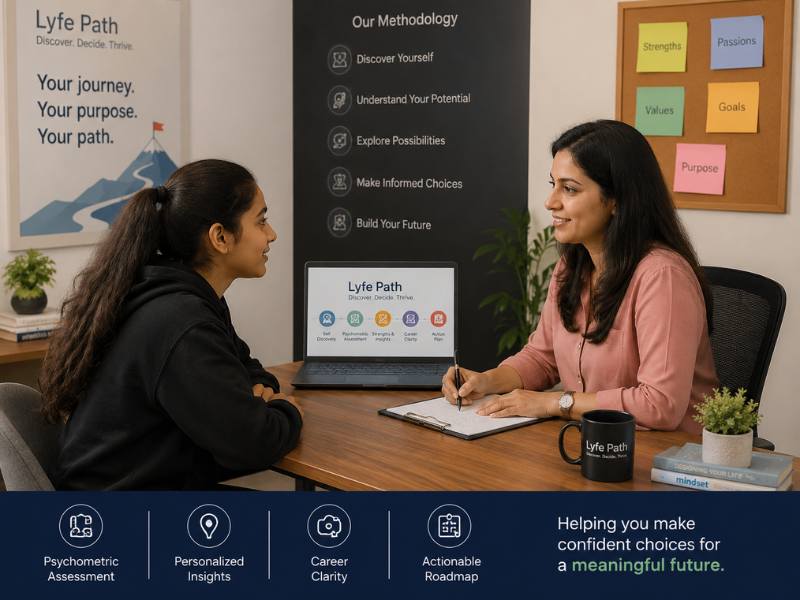
Career counselling is a structured, evidence-based process that maps your strengths, interests, values, and personality to real-world career options — and produces a concrete plan to get there. In 2026, you need it if you are making a major career decision without data to back it up. You don't need it if you already have both clarity and accurate information. Most people in India have neither. That's what this blog unpacks — including who actually benefits, who doesn't, and what separates a real career counselling process from a 30-minute conversation.
What Career Counselling Actually Is — And What It Isn't
The textbook definition won't help you much. Career counselling, at its core, is an intervention that answers one question: given who you are, where does the job market reward you?
Not "what do you like?" That's a hobby conversation. Not "what are your parents comfortable with?" That's a family negotiation. Not "what's a safe option?" That's fear management dressed up as planning.
Real career counselling operates at the intersection of three data sets: your psychometric profile (interests, personality, learning style, values, and aptitude), the current and projected job market, and the realistic education or training pathways that connect the two. A trained career counsellor holds all three simultaneously and identifies where they converge for you specifically.
What career counselling is not: a 30-minute chat where someone asks what subjects you like. Not a PDF report generated by an algorithm you've never spoken to. Not a list of "top 10 careers for science students." Those are information products. Career counselling is a diagnostic process backed by psychometric data — and the output is a direction and a plan, not a document.
The global career counselling and job training market was valued at USD 54 billion in 2024 and is projected to grow at 8% annually through 2033 (Business Research Insights, 2025). The world is spending more on career guidance than at any point in history. India is the country that needs it most and currently has the least of it.
The State of Career Guidance in India in 2026

Put the scale of the problem on the table before we talk about solutions.
India has more than 315 million students. The globally recommended counsellor-to-student ratio is 1:250. India's current ratio is approximately 1:3,000 — twelve times worse than that standard (Infigon Futures, 2025). The country needs 1.4 million trained career counsellors. It has fewer than 10,000.
The result: only 10–13% of Indian students receive professional career counselling before making their most consequential educational decisions (ETV Bharat / India Career Centre, 2025). The other 87–90% rely on what their parents chose, what scored highest in their board exams, or what the neighbour's son did successfully.
The downstream consequence is predictable: 93% of Indian students are aware of fewer than 10 career options out of more than 250 that exist (India Today survey, corroborated by multiple 2025 sources). They are selecting from an incomplete menu. Seventy percent report feeling confused about their career choices even after making them (Infigon Futures, 2025).
Approximately 65% of Indian graduates end up in roles unrelated to their field of study (India Career Centre, 2025). The mismatch between education and employment in India is not primarily a talent problem. It is a guidance problem — and it begins at Class 10 stream selection, years before the graduate enters the job market.
This is not a problem that AI career tools in 2026 have solved. They have widened access to information — but information without interpretation is noise. Knowing that "UX design is a growing field" is not the same as knowing whether you are suited to it, how to enter it from your current academic position, what it pays at 3, 5, and 10 years into a career, and what the Indian hiring market for it looks like right now. That interpretation is what counselling delivers.
If you are making career decisions based on what feels right, what sounds safe, or what someone else did successfully — you are working without data. Lyfe Path's psychometric assessment covers 6 dimensions in a single 300-question battery: RIASEC interests, Big Five personality, VARK learning style, motivators and values, aptitude, and MBTI type. Every result is followed by a 1:1 debrief — not a PDF and goodbye.
Who Actually Needs Career Counselling In 2026
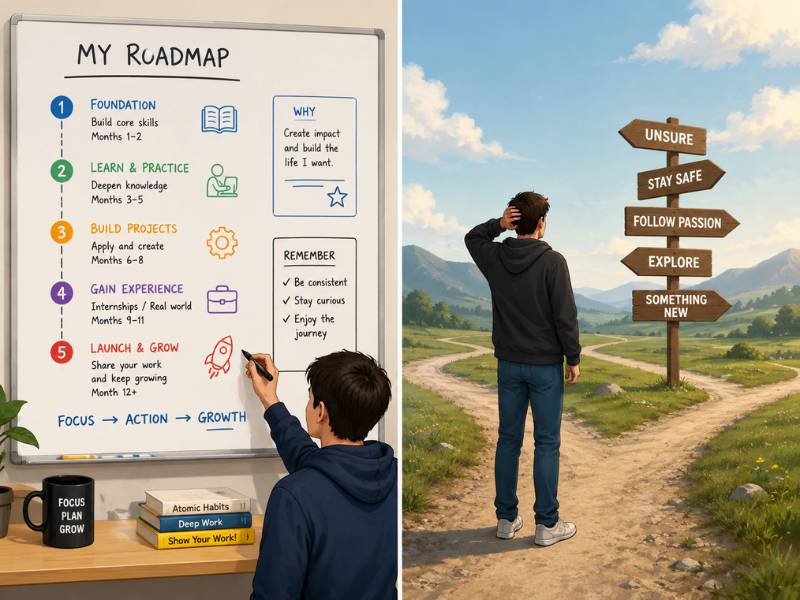
The answer is not "everyone." That's a lazy answer and it doesn't serve you. Career counselling is a specific intervention for a specific problem. Here is who has that problem.
Students In Class 8–12 Facing A Stream Or College Decision
This is the most critical window — and the most neglected. Stream selection after Class 10 (Science, Commerce, Arts) is routinely treated as a binary output of board exam scores. It is not. It is the first major career fork, and the wrong turn creates a compounding problem that plays out over the next 6–10 years of a person's life.
A student choosing Science because they scored 94% in Mathematics — without knowing whether they are investigative or social by temperament, without knowing what the actual hiring market for engineering looks like in 2030, without understanding whether data science, product design, or economics would align better with their personality profile — is not making a decision. They are following momentum.
Career counselling at this stage produces one thing above all others: the confidence to make an informed choice. Not necessarily a dramatic pivot from the expected path. Sometimes it validates that the "obvious" choice is genuinely the right one. That confirmation has real value — it removes years of second-guessing.
Mid-Career Professionals Who Feel Stuck Or Mismatched
The 28-year-old who is three years into a job they don't hate but can't bring themselves to care about. The 34-year-old who's been promoted twice and feels increasingly hollow about the work. The professional who has the title, the salary band, and a complete absence of motivation on Sunday evening.
This is a career fit problem, not a performance problem. The job market has rewarded them. Their psychometric profile — their actual interests, personality, and values — hasn't been part of the career equation. Career counselling at this stage doesn't mean quitting. It means understanding exactly why the mismatch exists and what a realistic, lateral correction looks like.
Career Changers Without A Clear Framework
People who know they want out but don't know where to go. The engineer who keeps gravitating towards marketing. The finance professional who wants to teach. The doctor who wants to write. These transitions are real, viable, and increasingly common in 2026 — but without a structured framework, they default to the most expensive and slowest escape route available (an MBA, typically) when a shorter, lateral path usually exists inside the same industry.
Anyone Making A High-Stakes Decision On Gut Feel Alone
If you are about to spend two years and significant money on a postgraduate degree, relocate internationally for a career, choose between two job offers with different long-term trajectories, or re-enter the workforce after a gap — and you are doing it based on instinct and informal conversations — you need structured data. Career counselling provides that data before the decision is made, not after.
Who Doesn't Actually Need Career Counselling

This section matters as much as the previous one. Misidentifying the problem wastes time, money, and emotional energy — and can deepen the confusion it was supposed to resolve.
People Who Have Clarity And Accurate Information Already
If you know what you want to do, you've researched the realistic pathways, you understand the current job market for that field, and the only thing between you and the goal is execution — you don't need career counselling. You may need a mentor, a skill development programme, or a career coach focused on how to get there. Those are different services, and conflating them with counselling leads to the wrong intervention.
People Whose Real Problem Is Family Alignment, Not Personal Clarity
This one is more common than most people admit, and it shows up in sessions constantly. The student who knows exactly what they want to do — has known for two years — but comes to a counsellor because their parents won't take the answer seriously. Career counselling will not fix that. The student already has the answer. What's missing is a different conversation — one that needs to involve the family directly, not the student alone in another assessment session.
People Who Need Mental Health Support Before Career Direction
Career anxiety that is rooted in generalised anxiety disorder, depression, or unprocessed trauma does not respond to career counselling. If the paralysis around career decisions is part of a broader emotional shutdown or mental health pattern, a clinical psychologist or mental health professional is the right first call. Career counselling can absolutely follow — but it cannot lead when the underlying issue is psychological, not directional.
People Who Need Skill Training, Not Direction
If the destination is clear, the plan is realistic, and the gap between here and there is a specific skill — Python, public speaking, financial modelling, UX tools — a targeted course or training programme closes that gap directly. Career counselling is a direction and fit tool. It is not a skill delivery mechanism. Using it as one is like asking a diagnostician to perform the surgery.
What Separates Real Career Counselling From A 30-Minute Conversation
In India especially, the word "counsellor" is used loosely — by school teachers allocated 20 minutes per student, by online platforms that deliver a percentile score and a career cluster with no human interpretation, by well-meaning relatives with 30 years in a single sector. Not all of this is career counselling. Some of it is barely career information.
Structured, evidence-based career counselling has five specific components that actually predict outcomes. A 2025 meta-analysis published in the Journal of Employment Counseling (Milot-Lapointe et al.) — the first comprehensive meta-analysis on individual career counselling — identified them precisely:
- Psychoeducation about the decision process — understanding how career choices are made and what distorts them, before attempting to make one
- Cognitive restructuring — identifying and correcting the false assumptions that drive poor decisions ("Engineering is the only real career," "Arts has no jobs")
- Written exercises and occupational analysis — structured research into what specific roles actually involve, not vague fields
- Individualised psychometric feedback — not a generic report, but a human debrief that connects your scores to your actual options
- Attention to real obstacles — financial constraints, family expectations, geographic limitations, confidence deficits — the things that don't show up in a test result but determine what's actually achievable
The same study found that 66% of career counselling clients experienced optimal change in career decision difficulty when these components were present. When they weren't — when the session was a generic conversation or a PDF report without debrief — outcomes dropped significantly.
At Lyfe Path, every client completes a 300-question psychometric battery covering six dimensions before the first conversation begins: RIASEC interests, Big Five personality, VARK learning style, motivators and values, aptitude and skills, and MBTI type. The 1:1 debrief then interprets those dimensions together — because knowing your interest type without your personality type is half a map. A career built on interest alone, without personality fit, burns out. A career built on personality alone, without interest alignment, hollows out. Both data sets matter.
Three sessions. Three different problems. All labelled "career counselling" when booked.
A mother booked a session for her 17-year-old daughter — "she doesn't know what to do after 12th." Fifteen minutes in, it was obvious the daughter had a very clear answer. She'd had it for two years. The confusion wasn't hers — it was the family's refusal to take the answer seriously. That's not a career counselling problem. That's a different conversation entirely, and it needed to happen with the parent in the room. We redirected the session on the spot. That's what a real diagnostic conversation does: it finds the actual problem, not the presenting one.
The most common thing I hear across sessions isn't "I don't know what I want." It's "I know what I want but I don't think it's a real option." That is not a career problem. It's an information problem layered on top of a confidence problem — and no aptitude test fixes that combination on its own. What it takes is evidence: salary data, market growth, real practitioners already doing the work, and a structured argument for why this particular person, with this particular profile, has a legitimate shot. That's the conversation that changes things.
A mechanical engineering graduate came to me eight months into his first job at a manufacturing plant — convinced that engineering wasn't for him. Hated the floor, hated the shifts, hated the noise. He wanted to do an MBA just to get out. We pulled apart what he'd actually engaged with across four years of college, and the pattern was consistent: systems, constraints, why things fail. Not building them. Analysing them. He was a natural fit for quality engineering and reliability — fields that sit inside engineering but look nothing like a factory floor. He didn't need an MBA. He needed a lateral move that would have taken three months, not three years and three lakhs. That's what the data showed. That's what he acted on.
Three different root causes. The presenting complaint in every case was "career confusion." The actual problem was different each time. That's exactly why the diagnostic matters — and why a conversation without data almost never finds the real issue.
— Luke De Souza, Lyfe Path
A Clear Action Plan: What To Do Right Now

- Name the actual question you're trying to answer. Is it "what should I do?" — that's a direction problem and career counselling applies directly. Is it "how do I do what I've already decided?" — that's an execution problem and coaching or mentoring applies. Most people conflate the two and end up in the wrong room.
- Take a structured psychometric assessment before any conversation. Not a free 10-question online quiz. A validated, multi-dimensional tool that covers interests, personality, values, and aptitude together — because each dimension alone is incomplete. The data changes the quality of every conversation that follows.
- Map your decision against current job market data. Not LinkedIn perception. Not what your college placement cell said in 2022. Current salary ranges, actual hiring volume, 5-year growth projections, and skill requirements in 2026. A career counsellor brings this context. Without it, you are optimising for a market that may no longer exist in the form you imagine.
- Identify the real obstacle — not the presenting one. Is it lack of direction? Lack of information? Family pressure? Confidence? Fear of a specific outcome? The intervention is different for each. Don't book career counselling when the real problem is family alignment — and don't book family mediation when you genuinely don't know which field fits your profile.
- Insist on a 1:1 debrief, not just a report. Any psychometric or aptitude assessment needs a trained professional to interpret it in your specific context. The report shows your scores. The debrief explains what those scores mean for your options, your constraints, and your next concrete step. One without the other is incomplete.
- Build a 90-day plan, not a 10-year vision. Career counselling should produce near-term, specific actions: what to research this week, what to apply for, what to stop pursuing, what to explore further. A 10-year vision is useful as context. A 90-day plan is what actually moves you off the spot.
If you've been sitting with this question longer than feels comfortable — the answer probably lives in your data, not your gut. Lyfe Path's 6-dimension psychometric assessment is the most rigorous career diagnostic available in India, followed by a 1:1 debrief with Luke. No templates. No PDF and goodbye. A real conversation about your real options, based on what your profile actually shows.
Frequently Asked Questions About Career Counselling
What is career counselling in simple terms?
Career counselling is a structured process where a trained professional helps you understand your strengths, interests, personality, and values — then maps those to real-world career options and a concrete action plan. It is evidence-based, not opinion-based. The output is a direction you can act on, not a general list of fields to explore.
Who needs career counselling in 2026?
Students in Class 8–12 facing stream or college decisions, mid-career professionals who feel mismatched or stuck, career changers without a clear framework, and anyone making a major career decision without psychometric data. If you are deciding based on pressure, peer influence, habit, or assumption — career counselling is the right intervention.
At what age should career counselling start in India?
Ideally by Class 8, or around age 13–14, before stream selection happens in Class 10. This gives students the data they need before the first major fork in the road. Most families wait until Class 12 or after graduation — by which point at least one significant, hard-to-reverse decision has already been made without guidance.
What is the difference between career counselling and career coaching?
Career counselling helps you identify the right direction — what to pursue and why, based on psychometric data and job market evidence. Career coaching assumes direction is already clear and focuses on execution — how to get there, build skills, and perform in the role. Most people need counselling first. Coaching is the logical follow-on once direction is set.
Does career counselling actually work?
Yes — when it includes the right components. A 2025 meta-analysis in the Journal of Employment Counseling (Milot-Lapointe et al.) found that individual career counselling produces moderate to large positive outcomes on career decision difficulty. 66% of clients experienced optimal change. The critical components: psychometric feedback, cognitive restructuring, and an individualised action plan — not a generic session or a report without debrief.
What happens in a Lyfe Path career counselling session?
Every client completes a 300-question, 6-dimension psychometric assessment covering RIASEC interests, Big Five personality, VARK learning style, motivators and values, aptitude, and MBTI type. The results feed a 1:1 debrief with Luke, where each dimension is interpreted in the context of the Indian and global job market — and a personalised career roadmap is built from the combined data. No two sessions are the same, because no two profiles are.
Is a psychometric test enough, or do I need counselling too?
A psychometric test gives you data. Counselling gives you interpretation, context, and a plan. A test result without a trained debrief is like a blood report without a doctor — the numbers are there, but the meaning and the next steps are not. The two work together. Neither replaces the other, and both are necessary for the output to be actionable.
How do I know if I need career counselling or something else?
If you don't know what you want — career counselling. If you know what you want but lack confidence or accurate information about whether it's viable — career counselling combined with mentoring. If you know what you want and your family won't accept it — a family alignment conversation, not a counselling session. If the paralysis goes beyond career and feels like broader anxiety or depression — a mental health professional is the right first call, with career counselling to follow once that foundation is in place.
A Final Word
Career counselling is not a luxury for students who can't make up their minds. It is a diagnostic tool for anyone making a high-stakes decision with incomplete information — which, in India in 2026, describes the vast majority of students and a significant proportion of working professionals.
The 93% statistic isn't just a data point. It represents a generation selecting their education, their training, and their first decade of work based on a menu they've never seen in full, with no structured process to evaluate what fits them. That's the gap Lyfe Path exists to close — not with a report, but with a rigorous process and a real conversation.
If you've read this far and you're still unsure whether you need it — that uncertainty itself is usually the answer. Come with your questions. We'll find out together what the data shows.
Thank you for spending time here. If you'd like to speak with Luke directly before committing to anything, reach out at info@lyfepath.in or call +91 93258 73738. No pressure. Just a conversation.
— Luke & the Lyfe Path team