

Best Career Options in India 2026: High-Paying Jobs With a Real Future — And the Psychometric Data Behind Choosing Yours
The highest-paying, most future-proof careers in India in 2026 sit across four sectors: AI and technology, financial services, specialised healthcare, and strategic consulting. But the list itself is not your answer. The answer is which one of these careers matches your specific personality, aptitude, interests, and values — because the wrong career in a high-growth sector will still leave you stuck. This blog gives you the data on where the market is going, and the framework for figuring out where you fit.

Why 2026 Is a Turning Point for Career Decisions in India
The Indian job market has not just grown in 2026 — it has restructured. The roles that absorbed millions of graduates five years ago — generic software engineering, entry-level IT services, MBBS general practice — are no longer where the serious opportunity is concentrated. New demand has emerged faster than the education system can supply qualified professionals to meet it.
The numbers are stark. According to NASSCOM and Deloitte's joint analysis, AI-related job demand in India is projected to reach 1.25 million by 2027 — yet only 16% of IT professionals are currently AI-skilled (Ministry of Electronics and IT, 2025). That gap between demand and supply is where the salary premiums live. And it is not limited to technology: the same supply-demand tension exists in specialised medicine, high-end financial services, and strategic consulting.
Key data point: India's national employability reached 56.35% in 2026 — up from just 46.2% in 2022 — according to the India Skills Report 2026 (ETS, CII, AICTE, Taggd). More than 90% of Indian employees are now working with generative AI tools. AI fluency is no longer a differentiator. It is the new baseline.
What this means for a student choosing a stream, a graduate picking a specialisation, or a mid-career professional considering a pivot: the question is not just "which field pays well?" The question is "which high-growth field do I have the personality, aptitude, and interest profile to actually succeed in?" Those are two very different questions. Only one of them has a personalised answer.
India's Highest-Paying Careers in 2026: The Real Numbers
The salary data below is drawn from Glassdoor India, AmbitionBox, NASSCOM, and LinkedIn India's 2025–26 workforce reports. These are realistic ranges — not aspirational peak figures pulled from a single outlier role.
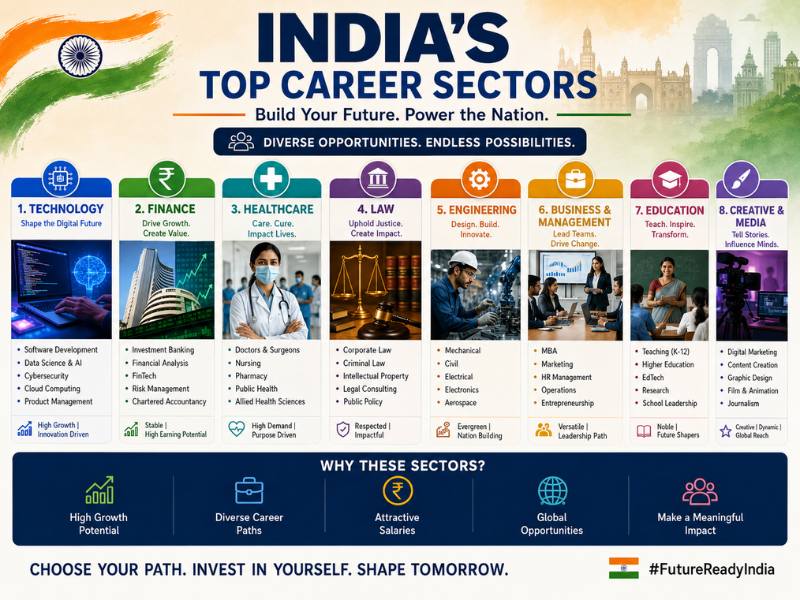
Technology and AI Careers
| Role | Entry (0–3 yrs) | Mid (4–8 yrs) | Senior (8+ yrs) |
|---|---|---|---|
| AI / ML Engineer | ₹12–18 LPA | ₹25–45 LPA | ₹60–1 Cr+ |
| Data Scientist | ₹10–15 LPA | ₹20–40 LPA | ₹50–80 LPA |
| Cybersecurity Specialist | ₹8–14 LPA | ₹18–35 LPA | ₹45–75 LPA |
| Cloud Architect | ₹10–16 LPA | ₹22–42 LPA | ₹55–90 LPA |
| Software Architect | ₹12–18 LPA | ₹25–50 LPA | ₹60 LPA–1 Cr+ |
Who fits these roles psychometrically: High Investigative and Realistic scores on RIASEC. Strong analytical aptitude and logical reasoning. Introversion-friendly environments with clear problem-solving frameworks. Big Five: high Openness and Conscientiousness. If your aptitude assessment shows strong numerical and abstract reasoning alongside genuine curiosity for how systems work, AI and tech careers are worth exploring seriously — not just because they pay well, but because you will not burn out doing them.
Financial Services and Fintech
| Role | Entry (0–3 yrs) | Mid (4–8 yrs) | Senior (8+ yrs) |
|---|---|---|---|
| Investment Banker | ₹12–20 LPA | ₹30–60 LPA | ₹80 LPA–2 Cr+ |
| Chartered Accountant | ₹7–12 LPA | ₹18–35 LPA | ₹40–80 LPA |
| Actuary | ₹8–14 LPA | ₹20–40 LPA | ₹50–1 Cr+ |
| Fintech Product Manager | ₹10–18 LPA | ₹25–50 LPA | ₹60–1.2 Cr+ |
India's fintech market is projected to reach USD 150 billion in 2026 (Invest India Report 2026), driving salary growth across the entire financial services ecosystem. Who fits: High Conventional and Enterprising scores on RIASEC. Strong numerical aptitude, attention to detail, and risk orientation. If your motivators assessment scores high on achievement and financial reward — and your aptitude shows numerical strength — finance careers offer one of the clearest correlations between effort, skill, and income ceiling.
Healthcare and Medicine
| Role | Senior Specialist | Notes |
|---|---|---|
| Anaesthesiologist | ₹2.5–3.5 Cr/yr | Highest salary ceiling in India across all professions |
| Surgeon (Super-Specialist) | ₹1–2.5 Cr/yr | Requires MBBS → MS → MCh pathway (12–15 yrs) |
| Radiologist | ₹80 LPA–1.5 Cr | AI-augmented diagnostics is the fastest-growing sub-field |
| Cardiologist / Neurologist | ₹1–2 Cr/yr | DM after MD; high subspecialisation premium |
Who fits: High Social and Investigative RIASEC scores. Exceptional patience, empathy, and stamina. VARK: multimodal learners with strong kinaesthetic and reading preferences. Big Five: high Agreeableness and Conscientiousness. Medicine has the highest salary ceiling in India — but also the longest runway (12–15 years to senior specialist income). Your motivators profile matters enormously here. If service, mastery, and impact score higher than speed-to-income on your values assessment, medicine is a genuine fit. If not, the 15-year path will feel like a sentence, not a vocation.
You've been reading a list. But a list is not a map.
Lyfe Path's psychometric assessment covers six dimensions — RIASEC, Big Five, VARK, Aptitude, Motivators, and MBTI — across 300 questions. The output is not a career name. It's a Career Cluster Map, a Subject Recommendation Engine, a Career Fit Score, a Gap Analysis, and a personalised Education and Career Roadmap. No other career counsellor in India delivers this combination with a 1:1 debrief included.
Take the Lyfe Path Assessment — find out which careers actually fit you →
Management Consulting and Strategy
Management consulting remains one of the highest-status and highest-compensation career tracks in India for MBA graduates. McKinsey, BCG, Bain, and top Indian firms (Kearney, Deloitte, EY-Parthenon) recruit from premier business schools at packages starting ₹25–40 LPA at entry level, with Partner-level compensation reaching ₹50 LPA to ₹5 Cr+ after 10–18 years. Who fits: High Enterprising and Investigative RIASEC. Strong verbal and numerical aptitude. Big Five: high Extraversion, Conscientiousness, and Openness. Motivators: achievement, influence, and variety. If your aptitude profile shows strong reasoning across domains and your Big Five registers high on intellectual curiosity and drive, consulting is worth serious consideration.
Law (Corporate and International)
Corporate law at top-tier Indian firms (AZB, Cyril Amarchand, Trilegal) offers salaries of ₹12–20 LPA at entry, rising to ₹80 LPA–1 Cr+ at the Partner level. International arbitration and M&A law have seen compensation grow significantly as India's cross-border deal flow accelerated in 2024–26. Who fits: High Investigative and Social RIASEC. Exceptional verbal reasoning aptitude. Big Five: high Conscientiousness and moderate Agreeableness. If your aptitude shows verbal dominance and your motivators score high on intellectual rigour and debate, law is frequently underexplored by Indian students who default to engineering or medicine without running the data.

Future-Proof vs High-Paying: Why These Are Not the Same Question
A career can be high-paying today and obsolete in seven years. It can also be future-proof and moderately compensated for a decade before the market catches up. The smartest career decisions in 2026 optimise for both — but they start from your profile, not from a ranked list.
The Indeed–NASSCOM 2026 report found that 86% of Indian employers have seen AI impact job roles and responsibilities, while 35% report significant redefinition or transformation. Nearly all organisations expect their 2026 workforce strategy to centre around AI-related or AI-supported roles. This does not mean everyone needs to become an engineer. It means every professional in every field needs to understand how AI intersects with their domain.
The four dimensions of a future-proof career:
1. Human-judgment intensity — Does the role require decisions that AI cannot yet make reliably? (Surgery, strategic consulting, legal advocacy, architecture.)
2. Domain + AI hybrid value — Does combining domain expertise with AI fluency create a premium? (AI-augmented radiology, fintech product management, data-driven marketing.)
3. Regulatory and compliance barriers — Is the field protected by licensing, accreditation, or statutory requirements? (Medicine, law, CA, aviation.)
4. Physical and relational presence — Does the work require embodied human interaction? (Healthcare, counselling, teaching, skilled trades.)
The careers that score highest across all four dimensions are the ones with the longest runway. Psychometric data tells you which of those four dimensions your personality and aptitude are built for.
What the NASSCOM Data Actually Means for Students Making Career Decisions Today
The headline number — 1.25 million AI jobs by 2027, only 16% of professionals currently AI-skilled — sounds like a simple "go into AI" message. It is not. Here is what it actually means, broken down by student profile.
If You Are a Class 11 or 12 Student Choosing a Stream
Your stream choice is not a career choice — it is a direction choice. Science keeps the most doors open, but only if you have the aptitude and interest to sustain it. Commerce is underrated and opens direct pathways to some of India's highest-paying careers (CA, investment banking, fintech, actuarial science) with far less competitive pressure than JEE. Humanities opens pathways in law, psychology, UX design, journalism, architecture, and public policy that are consistently underestimated in India.
The question is never "which stream pays the most." The question is which stream your aptitude, learning style, and interest profile are built for — because the stream you can excel in is worth infinitely more than the stream that looks good on paper but drains you by Class 12.
If You Are a Graduate Deciding on Specialisation or Higher Education
This is where the psychometric data is most decisive. A B.Tech graduate with a strong Enterprising and Social RIASEC profile and high verbal aptitude should seriously evaluate MBA over M.Tech — the career outcomes over a ten-year horizon are frequently better. A Commerce graduate with high Investigative aptitude and numerical strength should look at actuarial science, data analytics, or fintech before defaulting to an MBA. Specialisation decisions made without aptitude data are expensive mistakes.
If You Are a Mid-Career Professional Considering a Pivot
The most common mistake mid-career professionals make is pivoting toward salary rather than toward fit. Moving from marketing to product management because product managers earn more is a poor reason. Moving because your aptitude for systems thinking, your Investigative RIASEC score, and your Big Five Openness profile all point to product thinking — that is a data-backed pivot. The difference in three-year outcomes between a motivated-fit hire and a motivated-salary hire is enormous, and employers can tell the difference in interviews.
Architecture: The Career Nobody in the Room Had Said Out Loud
Kevin walked into my office with a printed list his parents had made — IAS, MBBS, or engineering. He was seventeen, polite, and had clearly been handed that list rather than asked to write his own.
The thing that shifted everything wasn't a test result or a report. It was one question I asked him: "When you lose track of time, what are you doing?" He said sketching buildings. Redesigning spaces in his head. Thinking about how a room makes people feel.
Nobody in that room had said the word Architecture once.
His parents took a moment. Then his father said, "Okay. Tell us more about that."
What the psychometric data confirmed afterwards — his Artistic and Realistic RIASEC scores, his strong spatial aptitude, his VARK kinaesthetic profile — was already showing up in what he did when nobody was watching. The assessment didn't discover Kevin's career. It gave his family the language and the evidence to have a conversation they hadn't known they needed to have.
Architecture in India in 2026 is not a fallback. Registered architects specialising in sustainable design, urban planning, and interior architecture are earning ₹15–40 LPA at senior levels, with independent practice potential far higher. More importantly — it was the right answer for Kevin. And the right answer is always worth more than the high-paying answer.
— Luke, Lyfe Path
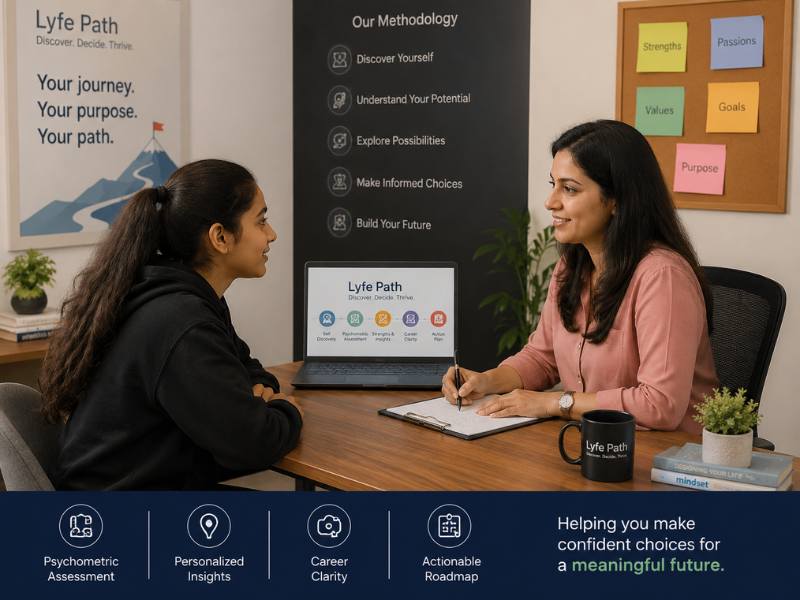
How to Choose the Right Career in India in 2026: A Step-by-Step Framework
This is not a generic action plan. Every step below is grounded in how the decision actually gets made well — and what skipping each step costs you.
- Run a 6-dimension psychometric assessment first. Before you look at any ranked list, get data on your RIASEC interests, Big Five personality profile, VARK learning style, motivators, aptitude across verbal/numerical/spatial/logical domains, and MBTI type. This takes roughly 2–3 hours and produces a Career Cluster Map that narrows the field from 500+ career options to 8–12 genuine candidates. Everything after this step is informed. Everything before it is guesswork.
- Map your clusters to current market data. Of the 8–12 career clusters your psychometric profile identifies, research current and projected demand in India. Use NASSCOM's annual reports, LinkedIn India Salary Insights, and the India Skills Report. Remove any cluster where the market is contracting or where AI automation risk is high over a 10-year horizon.
- Evaluate the educational pathway honestly. For each remaining career, map the exact educational route, cost, timeline to first income, and mid-career earning potential. Be realistic about competitive entry points (NEET, UPSC, JEE, CLAT, CA Foundation) and whether your aptitude profile gives you a real chance of clearing them.
- Assess your motivators and values alignment. A career that matches your aptitude but contradicts your motivators will plateau. A career that excites you but where your aptitude is weak will frustrate you. The overlap — high aptitude, strong interest, aligned motivators — is where the best career decisions live.
- Debrief with a qualified career counsellor. The data is necessary but not sufficient. A counsellor who can read your psychometric report, ask the right questions, and connect your profile to real-world career outcomes is the difference between a report gathering dust and a roadmap you actually follow.
- Build a 12-month skill plan aligned to your chosen direction. Whatever career you select, identify the top three to four skills that distinguish performers in that field in 2026. For tech: Python, ML fundamentals, cloud certification. For finance: Excel/financial modelling, CFA Level 1. For consulting: case frameworks, data storytelling. Start building before the degree starts, not after it ends.
If you've been reading this and thinking "but I still don't know which one is right for me" — that feeling is not a problem. It's the right starting point.
Lyfe Path's 300-question psychometric battery covers all six dimensions and produces five outputs: Career Cluster Mapping, Subject Recommendation Engine, Career Fit Scoring, Gap Analysis, and a full Education and Career Roadmap. Every client receives a personal 1:1 debrief with Luke — because a report without a conversation is just data without direction.
Book your Lyfe Path assessment today and turn uncertainty into a plan →
Frequently Asked Questions: Career Options in India 2026
Which career has the highest salary in India in 2026?
Medical specialists — anaesthesiologists, surgeons, cardiologists — hold the highest salary ceiling in India in 2026, followed by AI/ML engineers, investment bankers, and C-suite executives. Senior professionals in these fields earn between ₹50 LPA and ₹1 crore or more. That said, salary alone is a poor compass — the right career depends on your personality profile, aptitude, and values alignment, not just the pay bracket.
What are the most future-proof careers in India for 2026 and beyond?
AI engineering, data science, cybersecurity, and cloud architecture are the most future-proof technical careers in India right now. In non-tech sectors, management consulting, healthcare specialisation, and financial advisory roles remain highly resilient. The India Skills Report 2026 confirms that over 90% of Indian employees are already working with AI tools — so regardless of your field, AI fluency is now the non-negotiable baseline.
Which career option is best after Class 12 in India in 2026?
There is no single best career after Class 12 — the best career is the one that matches your RIASEC interest profile, aptitude, personality type, and values. Science students with strong analytical aptitude often thrive in engineering, medicine, or data science. Commerce students with persuasion skills and financial aptitude are well-suited to CA, investment banking, or fintech. Arts and humanities students with strong verbal reasoning frequently excel in law, UX design, psychology, or architecture. The only way to know which fits you is through structured psychometric assessment.
Is engineering still a good career option in India in 2026?
Engineering remains a strong career path in 2026, but the landscape has shifted significantly. Generic software engineering and entry-level IT services roles are under pressure from AI automation — NASSCOM reported tech sector workforce growth slowing to 2.3% in FY26. Specialised engineering roles — AI/ML engineering, cloud architecture, semiconductor design, and cybersecurity — are in high demand with salaries starting at ₹12–18 LPA for qualified freshers. Choosing the right specialisation within engineering matters far more than the degree itself.
Can I get a high-paying job in India without an IIT or top college degree?
Yes. NASSCOM data shows that Tier 2 and Tier 3 city students are actively being hired by Global Capability Centres and product companies for specialised roles. Platform-based hiring, certifications (AWS, CFA, PMP, Google), and demonstrable skills portfolios are increasingly valued over institution names. What you can do matters more than where you studied, particularly in AI, data analytics, and digital marketing roles.
How do I know which career is right for me?
The most reliable way is structured psychometric assessment across six dimensions: RIASEC (interests), Big Five (personality), VARK (learning style), Motivators and Values, Aptitude and Skills, and MBTI type. This combination reveals where your natural strengths and interests intersect with real-world career outcomes. A gut feeling about a career is a starting point — psychometric data turns that feeling into a confident, evidence-backed decision.
What skills are most in demand for high-paying jobs in India in 2026?
The Indeed–NASSCOM 2026 report identifies AI and data-related skills as the fastest-growing requirements across both management and technical roles in India. Specifically: Python and machine learning for technical roles; generative AI tool proficiency, data interpretation, and AI strategy for business roles; and cloud certifications (AWS, Azure) for infrastructure roles. Strategic thinking, communication, and cross-functional leadership remain the top differentiators at senior levels.
Is a government job still worth pursuing in 2026?
Government jobs remain a strong choice for individuals who score high on security orientation and public-service motivation in their values profile. At senior IAS level, total compensation including allowances can be equivalent to ₹25–50 LPA — below top private-sector roles, but with unmatched job security, housing, pension, and social impact. Whether it is right for you depends on your motivators, not market trends alone.

The Only Career List That Matters Is the One Built From Your Data
Every year, thousands of Indian students and professionals make career decisions based on what their parents chose, what their friends are doing, or what appeared at the top of a search result. Some of them get lucky. Most of them spend the next decade wondering why they feel out of place in the career they worked so hard to enter.
The job market in 2026 is more dynamic, more data-rich, and more meritocratic than it has ever been. The tools to make a genuinely informed career decision — psychometric assessment, market data, structured coaching — exist and are accessible. The only thing standing between you and a career that actually fits is the decision to start with data instead of assumptions.
Thank you for reading this far. It tells me you are taking this seriously — and that is exactly the right instinct. If you have questions about which careers might fit your profile, or if you want to talk through what a psychometric assessment would look like for your specific situation, I am always happy to have that conversation directly.
With warmth,
Luke De Souza
Career Coach & Founder, Lyfe Path
lyfepath.in | WhatsApp: +91 93258 73738