

Arts and Humanities students in India can access careers paying ₹12–50 LPA by 2026 — in UX research, corporate law, organisational psychology, civil services, digital strategy, journalism, and HR. The idea that choosing the arts stream means accepting lower earnings is not supported by current salary data or job market trends. What determines your earning potential is not your stream — it is the career you target within it, the institution you graduate from, and the skills you build alongside your degree. This blog maps seven high-paying career paths for arts and humanities students, with verified 2026 salary figures and the psychometric profile that fits each one.
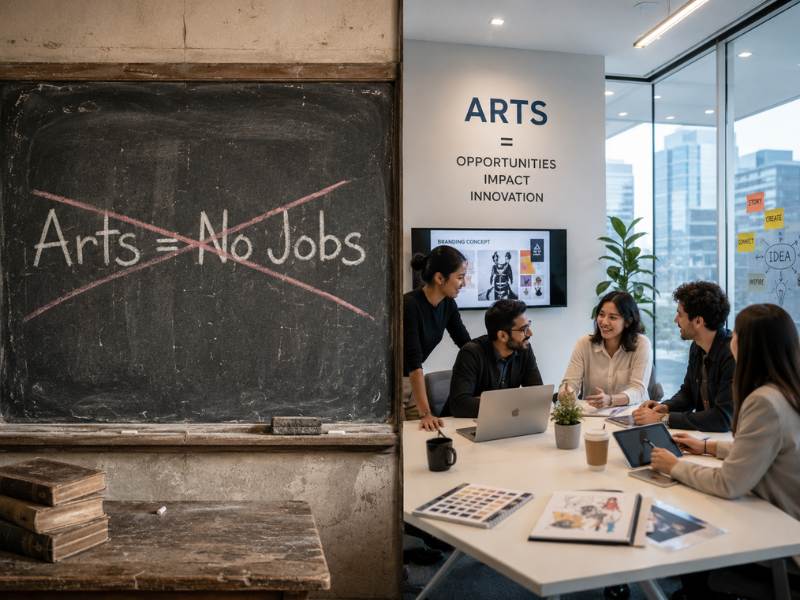
The perception gap: what people believe about arts careers versus what the 2026 job market actually shows.
Every year, thousands of Class 11 students choose the humanities stream and immediately start defending that choice to relatives at the dinner table. The argument they face is always the same: arts students end up as teachers or they end up struggling. It is repeated with such confidence that many students begin to believe it themselves by the time they reach their second year of graduation.
The World Economic Forum's Future of Jobs Report 2025 — drawing on data from over 1,000 companies across 55 economies — found that the fastest-growing skill categories globally are creative thinking, analytical reasoning, resilience, leadership, and social influence. These are not the skills you develop in a lab or a spreadsheet. These are the skills you develop when you spend three years reading literature, debating philosophy, analysing social structures, and learning how to construct an argument that moves a room.
Key data point: The WEF Future of Jobs Report 2025 projects 170 million new roles will be created globally by 2030. The skills most in demand — creative thinking, analytical reasoning, and human-centric leadership — are the core output of a humanities education.
India-specific: In 2026, corporate lawyers with 5+ years' experience earn ₹15–50 LPA. UX Designers with 3+ years earn ₹12–35 LPA. Senior Digital Marketing Managers earn ₹10–18 LPA. These are arts stream careers. Every single one of them.
The problem is not the stream. The problem is that most arts students receive career advice that is 20 years out of date, from well-meaning people who have never worked in a UX research lab, a corporate law firm, or a policy think tank.
That is exactly what career counselling — backed by psychometric data — exists to fix.
Not sure which career path your profile actually fits?
Lyfe Path's 6-dimension psychometric assessment maps your RIASEC interests, Big Five personality, learning style, motivators, aptitude, and MBTI type into a personalised career roadmap — built specifically for your data, not a generic list. If you've been second-guessing your stream, the answer lives in your profile, not your anxiety.
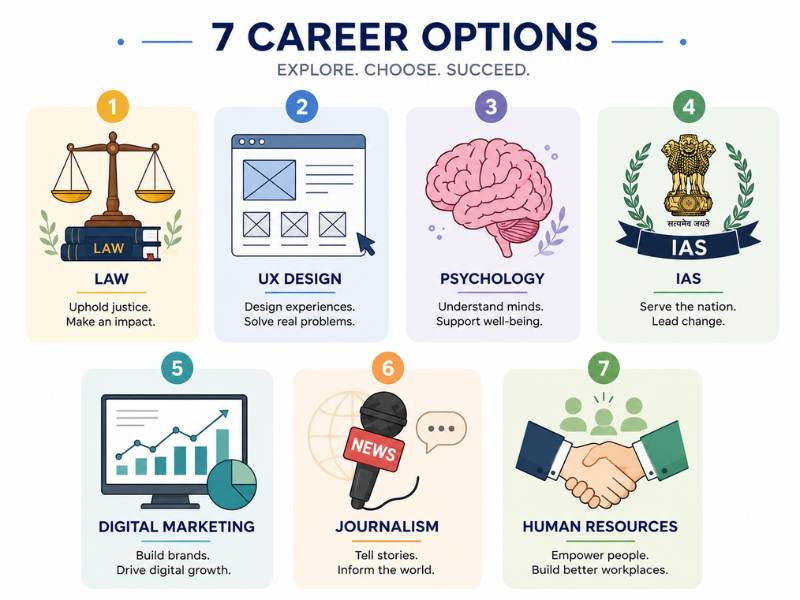
Seven career paths built on humanities skills — each with verified 2026 salary data from the Indian job market.
Why arts graduates win here: UX Research is the practice of understanding how humans think, feel, and behave when they interact with a product. It requires empathy, qualitative analysis, narrative construction, and the ability to synthesise complex human data into decisions a product team can act on. That is not a technology skillset. That is a humanities skillset.
What the role involves: User interviews, usability testing, journey mapping, persona development, and translating behavioural patterns into product recommendations. Content Strategists sit adjacent to this role — they define what a brand says, to whom, in what voice, and why.
Entry path: Any BA (Psychology, English, Sociology, Mass Communication) + UX certification (Google UX Design Certificate, Interaction Design Foundation) + portfolio of 2–3 case studies. No coding required.
Best psychometric fit: RIASEC profiles with strong Artistic and Investigative dimensions. High Openness and Agreeableness (Big Five). Verbal reasoning and abstract thinking in the upper range.
2026 hiring reality: Indian startups and mid-size tech firms are actively hiring UX Researchers at ₹8–14 LPA at the junior level. Senior UX Research leads at product companies earn ₹20–35 LPA. Bengaluru, Hyderabad, Pune, and remote roles dominate.
Why arts graduates win here: Law is built on argument, precedent, language, and the ability to read human intent through documentation. An English Literature or Political Science background trains exactly these capacities. The analytical rigour of a humanities education maps directly onto legal reasoning.
What the role involves: Contract drafting, corporate transactions, mergers and acquisitions legal support, intellectual property, regulatory compliance, and litigation. Corporate and IP law are the highest-paying specialisations in India's legal market.
Entry path: BA LLB (5-year integrated programme) from a National Law University (NLU), or LLB after any BA (3-year). CLAT is the primary entrance exam. Specialisation in corporate, IP, or international arbitration law unlocks the highest salaries.
Best psychometric fit: RIASEC with strong Enterprising and Investigative dimensions. High Conscientiousness and moderate Agreeableness (Big Five). Strong verbal reasoning and logical aptitude scores.
2026 hiring reality: Corporate lawyers at top-tier firms (AZB, Cyril Amarchand, Shardul Amarchand) with 5–7 years of experience regularly earn ₹25–40 LPA. Partners earn significantly more. Tier-2 law colleges can still produce strong earnings in litigation and government law — but the NLU pathway dominates corporate law salary outcomes.
Why arts graduates win here: Psychology is the scientific study of human behaviour — and it sits squarely within the humanities and social sciences. In 2026, its applications have expanded dramatically beyond therapy into corporate wellness, HR analytics, talent assessment, organisational development, and consumer behaviour research.
What the role involves: Clinical psychologists work in hospitals, schools, and private practice. Organisational psychologists work inside corporations — designing performance frameworks, managing change, and building people strategies. HR Analytics professionals combine psychology with data tools to measure workforce behaviour at scale.
Entry path: BA/BSc Psychology → MA/MSc Clinical or Organisational Psychology → RCI certification for clinical practice. A BA Psychology graduate who adds a data analytics certification is, as of 2026, exactly the profile large Indian corporations are competing for in HR.
Best psychometric fit: RIASEC with strong Social and Investigative dimensions. High Agreeableness and Openness (Big Five). Motivators pointing toward human impact and influence rather than financial security.
2026 hiring reality: Organisational psychologists at mid-to-large Indian corporations earn ₹15–20 LPA within 5–7 years. Clinical psychologists in private practice or corporate wellness programmes earn ₹12–18 LPA. India's National Mental Health Policy has structurally increased demand for certified psychologists in public institutions as well.
Why arts graduates win here: The UPSC Civil Services Examination is the most competitive exam in India — and the humanities stream has historically produced a disproportionate share of its toppers. History, Political Science, Geography, Public Administration, and Sociology are among the most popular and highest-scoring optional subjects in the Mains examination.
What the role involves: District administration, policy implementation, law enforcement, foreign service, and governance. IAS officers also move into policy consulting, think tanks, and international organisations post-service or after lateral entry.
Entry path: Any degree (humanities, science, or commerce) → UPSC CSE (Prelims, Mains, Interview). Serious preparation typically takes 2–3 years. BA in Political Science, History, or Public Administration provides the strongest subject alignment for the humanities optional papers.
Best psychometric fit: RIASEC with strong Social and Enterprising dimensions. High Conscientiousness and resilience markers (Big Five). Motivators heavily weighted toward social impact, public service, and long-term influence rather than financial maximisation.
2026 hiring reality: An IAS officer at District Collector level receives a salary equivalent of approximately ₹18 LPA including allowances, accommodation, and transport — with substantial non-monetary benefits. Senior IAS at Joint Secretary and above approach ₹25–30 LPA equivalent. The ceiling in terms of social impact and institutional authority has no parallel in the private sector.
Why arts graduates win here: Digital marketing is fundamentally the art of understanding what humans want, then communicating it in language that compels them to act. An arts graduate who understands narrative, audience psychology, and persuasive communication has a structural advantage over a commerce or engineering graduate in this field — provided they layer on the technical tools.
What the role involves: SEO strategy, paid media (Google/Meta), social media management, content marketing, email campaigns, conversion optimisation, and brand positioning. Performance marketing (paid acquisition) is the highest-paying specialisation within digital marketing in India right now.
Entry path: Any BA + Google Digital Marketing Certificate + Meta Blueprint + portfolio of live campaigns (even personal projects count). A strong portfolio built during graduation can open ₹4–6 LPA entry roles immediately.
Best psychometric fit: RIASEC with strong Enterprising and Artistic dimensions. Moderate-to-high Extraversion (Big Five). Motivators pointing toward recognition, influence, and visible impact.
2026 hiring reality: Digital marketing managers with 3–5 years of experience and specialisation in performance marketing or brand strategy earn ₹10–18 LPA at agencies and in-house corporate teams. Growth marketers at funded Indian startups can earn ₹15–22 LPA with ESOPs. Remote and freelance options are extensive.
Why arts graduates win here: India's media landscape in 2026 is bifurcated. Traditional print journalism is consolidating — but digital journalism, video journalism, investigative reporting, podcast production, and documentary research are growing at pace. The premium is no longer on the journalist who can write — it is on the journalist who can investigate, verify, and present complex truths in formats that digital audiences will actually engage with.
What the role involves: Reporting, writing, editing, video journalism, data journalism, podcast hosting, documentary research, and content strategy for digital news platforms. Investigative journalists with specialisation in finance, policy, or science earn significantly more than generalists.
Entry path: BA in Journalism/Mass Communication, or any BA + BJMC postgraduate, or MA Mass Communication from IIMC Delhi, ACJ Chennai, or Symbiosis Pune. Building a body of published work — even independently — while still studying is critical.
Best psychometric fit: RIASEC with strong Investigative and Artistic dimensions. High Openness (Big Five) with moderate-to-high Extraversion. Verbal aptitude in the top range. Motivators pointing toward recognition, truth, and social impact.
2026 hiring reality: Senior journalists and editors at major digital media organisations (The Wire, Scroll, The Print, NDTV Digital, Quint) earn ₹12–20 LPA. Foreign correspondents and investigative reporters can earn more. Specialised documentary researchers working with OTT platforms and international productions command ₹15–25 LPA project-based.
Why arts graduates win here: Human Resources has undergone a fundamental transformation in India's corporate sector. The old HR role — hiring, compliance, payroll — is being automated. What remains, and what is now commanding the highest salaries in the people function, is Organisational Development: designing culture, managing change, building leadership pipelines, and translating human behaviour data into strategic decisions. This is where humanities graduates — especially those with psychology or sociology backgrounds — have an enormous natural advantage.
What the role involves: Talent management, leadership development, culture design, change management, HR analytics, and people strategy at the board level. OD consultants also work independently or with consulting firms advising organisations on structure and performance.
Entry path: BA in Psychology, Sociology, or any humanities subject → MBA HR from a reputed institution (XLRI, TISS, SCMHRD), or MA in OD/HRD. XLRI's PMIR programme is widely regarded as the gold standard for HR careers in India.
Best psychometric fit: RIASEC with strong Social and Enterprising dimensions. High Agreeableness and Extraversion (Big Five). Motivators heavily weighted toward people impact, influence, and organisational belonging.
2026 hiring reality: HR Business Partners at large Indian corporations earn ₹12–20 LPA. OD Consultants with 8–10 years of experience earn ₹20–30 LPA or more. People Strategy leads at unicorn-stage startups are among the most sought-after (and well-paid) profiles in India's corporate talent market.

Career decisions made with data feel very different from career decisions made under pressure.
Every one of the seven career paths above is achievable from an arts and humanities background. But not every path is the right fit for every arts student. The mistake most students and parents make is treating career selection as a stream-level decision — "arts students should do law" — rather than a profile-level decision.
The truth is that an Enterprising-Social-Artistic RIASEC profile with high verbal aptitude and influence-driven motivators points toward very different careers than an Investigative-Artistic profile with high Openness and a preference for independent work. Both are arts students. Neither should receive the same career advice.
This is why psychometric data matters — not as a label, but as a lens. When you know your RIASEC interests, your Big Five personality dimensions, your aptitude profile, your learning style, and what genuinely motivates you, the career landscape stops being overwhelming and starts becoming legible. You can see which paths align with your natural strengths, which require skill-building, and which you would likely find depleting regardless of the salary they offer.
Lyfe Path's 6-dimension psychometric battery covers:
Every client receives a 1:1 debrief with Luke personally — because data without interpretation is just numbers.
Natasha came to me in her final year of BA English Literature — quiet, articulate, and completely convinced she had made the wrong choice. Her father, a government officer, had spent three years telling her that arts students "end up as teachers or nothing." She wasn't interested in teaching. She didn't know what she was interested in, beyond the fact that she loved understanding why people behaved the way they did.
When her assessment results came back, I paused before the debrief. Her RIASEC profile was Enterprising-Social-Artistic — a combination I rarely see that cleanly. Her Big Five showed exceptional Openness and Agreeableness paired with unusually high Conscientiousness for a creative profile. Her Motivators pointed toward influence, recognition, and human impact — not stability or structure. And her aptitude scores flagged strong verbal reasoning and above-average abstract thinking.
When I laid that out for her father, he went quiet for a moment. Then he asked: "So what does someone like her actually do?"
I said: someone with this profile doesn't just work in a field — they shape it. UX Research, Content Strategy, Corporate Communications, HR and Organisational Development, Policy Consulting — these are 2026's high-demand careers, and every single one of them is built on the exact skill set an Arts education develops: reading people, constructing narratives, synthesising complexity into something a room full of humans can act on.
Natasha is now in a UX Research role at a Bengaluru startup, earning more in her second year than her father expected her to earn in her fifth.
Her parting message to me: "I just needed someone to show me the data."
— Luke De Souza, Founder, Lyfe Path
Your career data is waiting.
Lyfe Path's full assessment and counselling programme covers 6 psychometric dimensions across 300 questions, produces a personalised Career Fit Score and Education Roadmap, and includes two 1:1 counselling sessions with Luke — plus a year of WhatsApp support as you navigate your path.
If you've been asking yourself "what do I do with my arts degree?" for a while — the answer lives in your data, not your uncertainty.
What are the highest paying career options for arts students in India in 2026?
The highest paying careers for arts graduates in India in 2026 include corporate law (₹15–50 LPA at senior levels), UX research and design (₹12–35 LPA with 3+ years), civil services IAS/IPS (₹8–30 LPA), organisational psychology (₹20+ LPA in corporates), and senior digital marketing roles (₹10–18 LPA). Salary outcomes depend on your institution, specialisation, and the additional skills you build alongside your degree.
Is the arts stream a good choice for students who want to earn well in India?
Yes — with the right direction and planning. Arts students who pair their humanities education with a focused specialisation and build a portfolio of demonstrable work can achieve salaries of ₹10–25 LPA within five years. The stream is not the limiting factor. The absence of a structured career plan is.
Which courses after 12th arts lead to the highest salary in India?
BA LLB (integrated 5-year law), BA Psychology followed by an MA or organisational certification, UX Design programmes from NID or certified platforms, and BA Economics or Political Science leading into public policy or civil services are among the highest-earning pathways. Digital marketing certifications added to any BA can substantially raise early salaries without extending study time.
Can an arts student get into UX design or tech-adjacent roles without knowing coding?
Yes. UX Research and Content Strategy roles are built on empathy, communication, and behavioural analysis — core strengths of humanities graduates. Coding is not required. Tools like Figma, Maze, and Dovetail are learnable in weeks. What companies pay a premium for is the ability to understand human behaviour and translate it into product decisions — exactly what an arts education trains you to do.
How does a psychometric assessment help an arts student choose the right career?
A psychometric assessment maps six dimensions of your profile — interests (RIASEC), personality (Big Five), learning style (VARK), motivators and values, aptitude, and MBTI type. This data shows which careers align with how you think, what drives you, and where your natural strengths lie. For arts students, it often uncovers high-fit careers in UX research, policy consulting, or organisational development that they had never considered — because no one had shown them the data before.
Is law a good career option after 12th arts in India in 2026?
Law is one of the most financially rewarding career paths for arts students in India, but outcomes depend heavily on institution and specialisation. Corporate lawyers at top firms with 5+ years of experience regularly earn ₹25 LPA and above. The path requires an integrated BA LLB (5 years) or LLB after graduation (3 years), followed by specialisation in corporate, IP, or international law for the highest earning potential.
What careers in arts have the best job security in India right now?
Civil services offer the strongest job security with strong equivalent pay. Clinical and organisational psychology is growing rapidly due to India's National Mental Health Policy and corporate wellness mandates. HR and Organisational Development roles are recession-resistant. UX research is structurally insulated from automation because it requires human empathy and qualitative interpretation that AI cannot replicate.
My parents think arts has no future — what data can I show them?
The World Economic Forum's Future of Jobs Report 2025 confirms that the fastest-growing skills globally — creative thinking, analytical reasoning, leadership, and social influence — are precisely what a humanities education develops. In India, arts graduates in corporate law, UX design, and civil services are earning ₹15–50 LPA at senior levels. The data does not support the view that arts leads to low pay. Career planning — not stream selection — is the deciding factor.

Thank you for reading this far. I know how heavy this question can feel — especially when you're surrounded by people with strong opinions and limited data. The arts stream is not a consolation prize. It is a foundation for some of the most meaningful and genuinely well-paying careers in India's 2026 job market. But knowing that intellectually is not the same as knowing which of those careers is the right fit for you.
That is what I do at Lyfe Path — help you find that answer through data, not guesswork. If you'd like to talk through your specific situation, reach out. Every Lyfe Path client gets a 1:1 debrief with me personally, because no two profiles are the same and no two conversations should be either.
Wishing you clarity, courage, and the right data to make this decision with confidence.
— Luke De Souza
Founder, Lyfe Path | Career Coach & Psychometric Assessment Specialist
lyfepath.in | WhatsApp: +91 93258 73738