

How to Prepare for a Career Counselling Session for Nearly 4.5X the Value
The single biggest predictor of how useful a career counselling session turns out to be isn't the counsellor's experience — it's how prepared the client walks in. Research on career interventions shows that sessions built around structured self-assessment and written reflection produce effect sizes nearly 4.5 times larger than sessions where a client arrives with nothing done beforehand. Preparation decides the outcome before the conversation even starts.

Why Preparation Changes the Outcome, Not Just the Mood
Most people assume that showing up is the hard part — that once you're sitting across from a counsellor, the conversation itself will do the work of finding clarity. The data on career counselling doesn't support that assumption. What actually determines whether a session produces a real decision or just a pleasant hour of talking is what each side brings into the room.
A landmark 2000 meta-analysis by researchers Steven Brown and Nancy Ryan Krane examined decades of career counselling outcome studies and identified which components of a session actually moved the needle. They found that sessions built around written self-assessment exercises and individualised feedback — meaning the counsellor responding to the client's specific data rather than giving generic advice — produced dramatically stronger results. Sessions with none of these critical components produced an average effect size of just 0.22. Sessions that combined these components produced effect sizes as high as 0.99 — nearly 4.5 times greater.
This wasn't a one-off finding. A 2017 replication by Whiston and colleagues, covering 57 separate studies and more than 7,300 participants, confirmed the same pattern: written exercises, individualised feedback, and occupational information were the components most reliably linked to stronger outcomes.
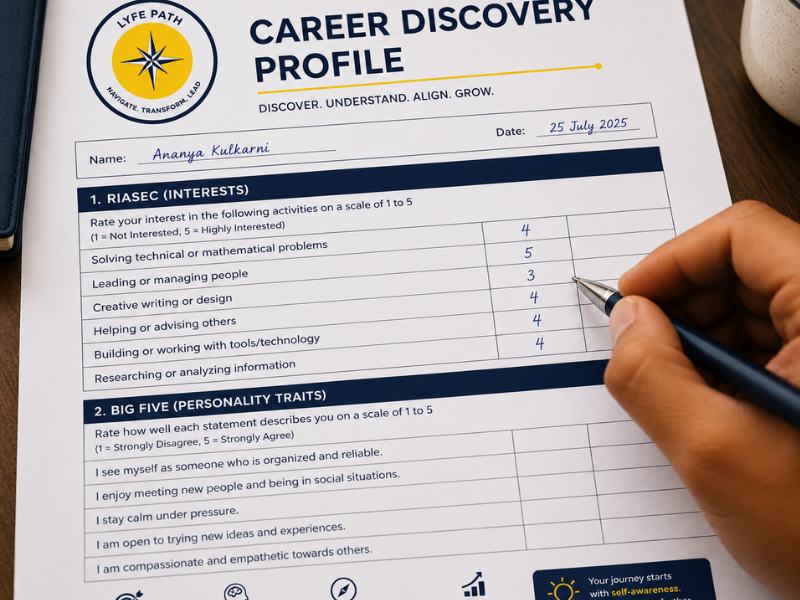
Here's why this matters practically: a counsellor cannot give individualised feedback on data they don't have. If a client walks in without having completed any self-assessment or written reflection, the first part of the session is spent gathering basic information that could have been captured in advance — leaving less time for the actual analysis and roadmap-building that make counselling worth the appointment. Preparation isn't a courtesy to the counsellor. It's what allows the session to start where it should.
What "Preparation" Actually Means Before a Career Counselling Session
Preparation doesn't mean knowing the answer before you walk in — if you already knew, you wouldn't need the session. It means arriving with enough structured information that the conversation can move straight to analysis instead of starting from a blank page.
Complete a Structured Self-Assessment First
A proper psychometric assessment — one that looks at interests, personality traits, aptitude, motivators, and learning style — gives your counsellor the "individualised feedback" ingredient the research points to. Without it, a counsellor is often working from a short conversation and general impressions. With it, the session becomes a discussion of your actual data: where your interests and your aptitude agree, where they pull in different directions, and what that means for the options in front of you.
Write Down What's Actually Bothering You
Before the session, spend ten to fifteen minutes writing — not typing a polished paragraph, just notes — on what specifically feels unresolved. "I don't know what to do" is a feeling, not a starting point. "I'm choosing between Commerce and Science and I don't know which one keeps more doors open" is something a counsellor can actually work with. This is the written-exercise component the research consistently links to stronger outcomes.
Bring Documents That Add Real Context
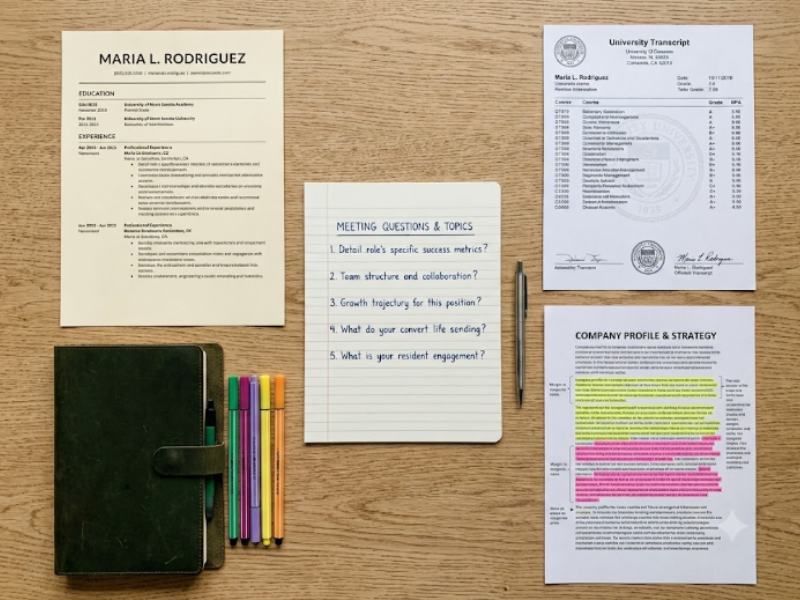
Academic transcripts, a resume if you have one, past test scores, or feedback you've received from a teacher, manager, or previous counsellor all add texture that a single conversation can't recover. None of this needs to be formal — a photo of a report card is enough. What matters is that the counsellor isn't reconstructing your history from memory in real time.
Walk in With One Clear Question
Of everything on this list, this is the easiest to skip and the one that changes a session the most. Pick one specific question you want answered by the end of the appointment. Not "what should I do with my life" — something narrower, like "given my results, does a design career actually fit someone like me, or am I drawn to it for the wrong reasons." A vague session produces a vague outcome. A specific question produces a specific answer.
How Different People Should Prepare for a Career Counselling Session
The core preparation steps stay the same, but what they look like in practice shifts depending on who's walking into the session.
Class 10 and 12 Students
For a student choosing a stream or a course, the assessment matters more than the documents. A completed psychometric assessment gives the counsellor something concrete to weigh against exam pressure, peer choices, and family expectations — all of which tend to crowd out the student's own actual interests in an unprepared career counselling session. One clear question ("does my aptitude actually support Engineering, or am I choosing it because everyone else is") does more than a vague hope for direction.
Parents Booking a Session for a Younger Child
The most useful thing a parent can do before a career counselling session is make sure the child completes the assessment themselves — not fill it in on their behalf, and not sit beside them influencing each answer. The written notes and the one clear question should come from the child too. A session prepared by the parent but attended by the child rarely lands, because the data on the table doesn't actually belong to the person the advice is for.
Working Professionals Considering a Change
For someone weighing a career switch, documents carry more weight than they do for a student: a resume, recent performance reviews, and a short note on what specifically feels wrong about the current role — is it the work itself, the environment, the growth ceiling, or the people. A career counselling session with this laid out in advance can move straight into whether the frustration points to a different role, a different industry, or a different way of working entirely.
Women Returning to Work After a Break
Preparation here often means being explicit about constraints before the session starts — location, hours, and the kind of role that fits the current stage of life — alongside the assessment. Naming these upfront means the session isn't spent discovering constraints halfway through, and can instead spend its time matching interests and aptitude against options that are actually workable.
Students and Professionals Preparing to Study or Work Abroad
Here, preparation should include whatever research has already been done — shortlisted countries, courses, or visa routes — even if it's incomplete. A counsellor can only sharpen a direction that already exists on paper; without it, a session risks staying at the level of "where should I even look," which a single appointment usually can't resolve on its own.
What the Data Says About India's Preparation Gap
This isn't just a global research finding — it maps directly onto a gap that shows up repeatedly in Indian career guidance data. The 2024 Annual Student Quest Survey, conducted by the IC3 Institute in collaboration with FLAME University across more than 35,000 school counsellors and 2,200 students, found that while 68% of Indian students report having access to some form of counselling, 38% specifically cite a lack of personalised feedback as one of their biggest frustrations with the process.
That statistic is telling. Personalised feedback is not something a counsellor can manufacture out of a 45-minute conversation alone — it depends on the client bringing enough personal data into the room for the feedback to be personal in the first place. Separately, research from Infigon Futures (2025) found that 93% of Indian students are aware of ten careers or fewer, out of more than 250 documented options. A single unprepared session cannot close a 240-option awareness gap. A session built on a completed assessment and specific questions has a real shot at narrowing it.

There's a second reason this matters more in India than in many other places: access itself is scarce. India has an estimated 10,000 trained career counsellors for a school and higher-education population of more than 30 crore — a ratio of roughly 1 counsellor for every 3,000 students, against a globally recommended ratio closer to 1:250. When the session itself is hard to get, an unprepared one is a much bigger loss than it would be somewhere with easier access to follow-up appointments.
At a glance:
- Career counselling sessions with no structured preparation: average effect size 0.22 (Brown & Ryan Krane, 2000)
- Sessions combining self-assessment, individualised feedback, and occupational information: average effect size 0.99 — nearly 4.5X greater
- 38% of Indian students say lack of personalised feedback is a top frustration with career counselling (IC3 Institute & FLAME University, 2024)
- 93% of Indian students are aware of ten careers or fewer, out of 250+ documented options (Infigon Futures, 2025)
Over the years, I've noticed the same pattern show up in almost every session I run. The clients who walk in having done even a little groundwork — a few written notes on what's bothering them, a completed assessment, one clear question they want answered — leave with something concrete: an actual roadmap, a next step, a decision they can act on. The ones who walk in cold, hoping the session itself will hand them clarity, usually leave with more questions than they came in with.
It took me a while to learn this the hard way — I used to assume the session would do all the work. Now everything happens before we even sit down. I send the assessment digitally, they complete it in their own time, and by the time we talk, I already have real data in front of me instead of a blank page. It changes the entire conversation — and it makes the client more accountable too, because they've already started the work themselves.
If you've been asking yourself this question for a while, the answer probably lives in your data — not your gut. Take Lyfe Path's psychometric assessment before your next session and walk in with something real to work from.
Your Pre-Session Action Plan
- Complete a structured assessment 2–3 days before your session — not the morning of. This gives your counsellor time to actually review it, not skim it in front of you.
- Spend 10–15 minutes writing down what's genuinely undecided or confusing you. Be specific rather than general — specificity is what makes the writing useful.
- Gather documents that add context — transcripts, a resume, past test scores, or feedback you've received from a teacher or manager.
- Write down the one question you most want answered by the end of the session, and keep it in front of you.
- Decide in advance what "useful" would look like for you, so you have a way to measure whether the session actually delivered it.
Common Mistakes People Make When Preparing for a Career Counselling Session
Most of these aren't about laziness — they're about not knowing what "prepared" actually means until it's spelled out.
- Filling out the assessment the night before, rushed. A psychometric assessment done in ten distracted minutes produces noisy data. Your counsellor's feedback is only as individualised as the information behind it.
- Bringing a question that's really a decision already made. "Convince me Engineering is right for me" isn't a question — it's a request for validation. A career counselling session works best when the question is genuinely open.
- Letting someone else write the notes. When a parent, partner, or well-meaning relative writes down what they think is confusing the client, the session ends up solving the wrong problem.
- Treating the session as the only step. One appointment, however well prepared, rarely produces a lifetime decision on its own. Preparation gets you a strong first session — not a finished plan by the time you stand up.
- Skipping preparation because "the counsellor will figure it out." A skilled counsellor can work with very little, but a session built on guesswork covers less ground than one built on real data, no matter how experienced the counsellor is.
Frequently Asked Questions
Do I need to prepare anything before my first career counselling session?
Yes. Research on career counselling outcomes shows that sessions built on some prior self-reflection or self-assessment produce significantly better results than sessions where the client arrives with nothing done. Even 15–20 minutes of preparation changes how much a first session can achieve.
What should I bring to a career counselling appointment?
Bring a completed self-assessment if one has been given to you, academic records or a resume, any past test scores or feedback you've received, and a short written list of what's actually confusing you. These give your counsellor real information to work with instead of starting from zero.
Is it okay to go into a career counselling session without knowing what I want?
Yes — not knowing is normal, and it's often the reason people book a session in the first place. But "not knowing" and "not having thought about it at all" are different starting points. Even writing down what feels confusing, without having an answer, gives the session something concrete to work from.
How long before the session should I complete a career assessment?
Ideally 2–3 days before, not the morning of. This gives your counsellor time to review your results and prepare a session tailored to your actual data, rather than reading it for the first time in front of you.
What questions should I ask my career counsellor?
Ask questions specific to your situation rather than general ones. Instead of "what should I do with my life," try "given my results, which of these two streams fits me better" or "what does my assessment say about roles I haven't considered." Specific questions get specific, usable answers.
Does preparation actually change how the session goes?
Yes. A 2000 meta-analysis by Brown and Ryan Krane, later replicated by Whiston and colleagues in 2017 across more than 7,000 participants, found that career counselling built around written self-assessment and individualised feedback produced effect sizes nearly 4.5 times larger than sessions without this preparation.
What if I don't have test scores or academic records to bring?
That's fine — documents help, but they aren't the most important part. A completed self-assessment and a written note on what's bothering you matter more than paperwork. Bring what you have and don't delay a session waiting to gather records.
Can parents help a student prepare for career counselling?
Yes, especially for younger students. Parents can help by making sure the assessment is completed ahead of time, encouraging the student to write down their own questions rather than the parent's, and letting the student lead what gets discussed in the session.

Before You Book Your Next Session
None of this is about making career counselling harder to access — it's about making the hour you already have count for more. The research is consistent, and the pattern holds up in session after session: preparation isn't a formality, it's the difference between a conversation and a decision.
Thank you for reading this far — if you're weighing a session for yourself, your child, or someone you're guiding, I hope this gives you a clear place to start. If you'd like to talk through where you're stuck before you book anything, I'm always happy to connect directly.
Ready to walk into your next session already ahead? Start with Lyfe Path's psychometric assessment and bring real data to the conversation, not just questions.
Warmly,
Luke & the Lyfe Path team