

How to Choose the Right Career Counselor in India — A Practical, No-Nonsense Guide
The right career counselor will change the trajectory of your life. The wrong one will take your money, hand you a printout, and leave you exactly where you started — except now you're out of time and money too. Here is how to tell them apart before you book a single session.

Why This Decision Is Harder Than It Should Be
India has over 26.5 crore school students and approximately 10,000 trained career counselors — a ratio of roughly 1:3,000, compared to the internationally recommended standard of 1:250 set by the International School Counsellors Association. That gap has created a vacuum, and that vacuum has been filled by people who are not qualified to fill it.
According to a UN study cited by ETV Bharat in 2025, only 1 in 10 Indian students receives any form of professional career guidance. For the other nine, career decisions are shaped by family pressure, neighbourhood advice, and whatever stream their school pushed them toward. The consequences are measurable: the India Skills Report and NASSCOM surveys have found that nearly 50% of Indian graduates are considered unemployable by industry standards, with engineering graduates faring worst — only 20–25% deemed job-ready.
The point is not to alarm you. The point is this: because the field is under-regulated and the demand is enormous, almost anyone can call themselves a career counselor in India. Which means choosing one is not a minor administrative task. It is, itself, a career decision — and it deserves the same rigour.
The scale of the problem: India needs approximately 1.4 million career counselors to serve its student population at the globally recommended ratio. It currently has around 10,000 trained practitioners. That shortfall has created a market full of well-meaning but unqualified voices — and a handful of genuinely excellent ones. Your job is to find the latter.
Step 1: Understand What You Actually Need
Before you evaluate anyone else, get clear on where you are and what kind of help would actually move you forward. Career counseling is not one thing — it covers several distinct situations, and the right practitioner for one may not be the right one for another.
You are probably looking for a career counselor if you are a student in Class 10–12 trying to choose a stream or board, a graduate unsure which field genuinely suits you, or a young professional who entered a career and realised within a few years that something is off. Career counselors use structured assessment tools — psychometric inventories, aptitude batteries, interest profiles — to help you build a picture of where your skills, personality, and interests actually converge, and what kinds of careers that convergence points toward.
You may be looking for a career coach if you are already established in a career and need help with advancement, salary negotiation, transitioning into a new role, or preparing for interviews and leadership. Career coaching tends to be more tactical and forward-focused, less about discovery and more about execution.
Many practitioners in India blend both. That is fine — as long as they have the tools and training to deliver both well. What you want to avoid is a generalist who does neither properly.
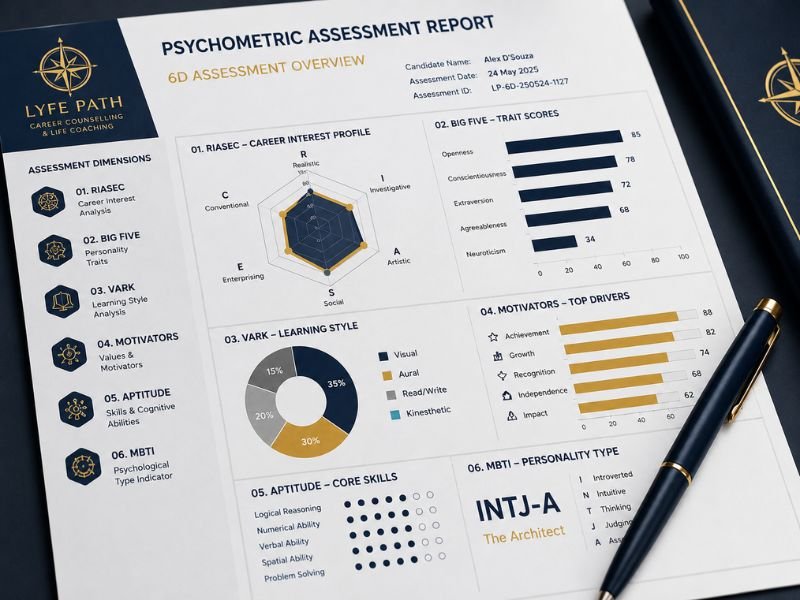
Not sure which category you fall into? That confusion itself is useful data. Lyfe Path's career assessment covers six psychometric dimensions — interests, personality, learning style, aptitude, values, and motivators — and produces a 30+ page personalised career report, debriefed 1:1 by Luke personally. It's designed for exactly this moment: when you know something isn't right but can't yet name what.
Step 2: Check Their Credentials — And Know What to Check For
Career counseling in India is not a regulated profession. Anyone can use the title. That is not a criticism of the field — it is a structural reality you need to factor into your evaluation. It means credentials matter more here, not less, because there is no licensing body doing the screening for you.
Qualifications Worth Trusting
Look for counselors who hold one or more of the following:
- Postgraduate degree in psychology, counseling, or education — an MA, MSc, or MEd with a counseling specialisation provides the foundational training to interpret human behaviour and psychometric data responsibly.
- Certification from a recognised body — in the Indian context, credible programmes include the Global Career Counsellor (GCC) certification by Univariety in partnership with UCLA Extension, certifications from iDreamCareer, or the NCDA (National Career Development Association) credentials for practitioners with international training.
- NLP Practitioner or Master Practitioner certification — relevant when the counselor works with belief systems, self-limiting patterns, and behavioural change alongside career guidance, not just assessment.
- Demonstrable training in psychometric tools — ask specifically which instruments they are certified to administer and interpret. RIASEC inventories, Big Five assessments, Holland Code tools, and aptitude batteries all require proper training to use well.
Credentials from a weekend workshop, a self-declared "institute," or an unverifiable online certificate are not equivalent. Ask for specifics. A qualified practitioner will welcome the question.
Step 3: Ask About Their Methodology — Not Just Their Experience
Experience matters. But methodology matters more. A counselor who has seen a thousand clients and is still going on gut instinct is more dangerous than a well-trained practitioner with a smaller client list, because they are confidently wrong.
Ask any counselor you are considering these four questions before you commit:
- What assessments do you use, and why those specific ones? They should be able to name the tools, explain what each one measures, and describe how they combine the results into a coherent picture. Vague answers like "we use personality tests" are not sufficient.
- How many dimensions does your evaluation cover? A credible assessment covers at minimum: career interests (RIASEC), personality (Big Five or MBTI), and aptitude. A genuinely rigorous one also covers learning style (VARK), values and motivators, and skills mapping. A single-dimension assessment — "we just do MBTI" — is not enough to make major career decisions from.
- Do I get a written report, and do we go through it together? Any counselor worth working with produces a written output and conducts a personal debrief. A report handed over without explanation is not counseling — it is a transaction.
- What does your follow-up process look like? Career decisions are not made in one sitting. A good counselor builds in a roadmap conversation, checks in on progress, and is accessible for questions after the initial engagement.
A useful benchmark: Lyfe Path's assessment uses three psychometric instruments covering six dimensions — RIASEC, Big Five, VARK, Aptitude & Skills, Motivators/Values, and MBTI — producing a 300-question battery and a 30+ page personalised career report. Every client receives a 1:1 debrief with Luke personally, plus a career roadmap covering education paths, subject recommendations, and career fit scoring. That is the standard a rigorous process meets. Use it as your reference point when evaluating others.
Step 4: Know the Red Flags — Before You Walk In
The markers of a poor career counselor are often more obvious than people expect, but only if you know what to look for before you're already sitting in the session and feeling the social pressure to trust the person in front of you.

Seven Red Flags to Walk Away From
| Red Flag | What It Signals |
|---|---|
| ✗ Very short first session with no structured assessment | They are going on impression, not data. Impressions are wrong far more often than people admit. |
| ✗ A printed report handed over without a debrief | The report is the beginning of the conversation, not the end of it. If they hand it over and walk away, the process was never designed for your benefit. |
| ✗ Guaranteed outcomes or placement promises | No ethical counselor guarantees specific results. Anyone who does is selling you something, not guiding you. |
| ✗ Pressure to buy a large package upfront before you have seen their process | Confidence in the work means transparency about the work. Pressure to commit before you understand what you are committing to is a commercial tactic, not a professional one. |
| ✗ No clear explanation of methodology | If they cannot explain how they arrive at their recommendations — or if their answer is "experience" and "intuition" — their recommendations are not grounded in anything you can evaluate or trust. |
| ✗ Recommending popular careers regardless of your profile | Engineering, medicine, MBA — these are defaults. A counselor pointing every client in the same direction is reflecting cultural pressure, not psychometric data. |
| ✗ No knowledge of current job market trends | Career counseling is not just about who you are — it is about how who you are fits into a labour market that is changing faster than at any point in the last fifty years. If they cannot speak to AI-driven job displacement, emerging sectors, or industry-specific demand in India right now, their roadmap is built on outdated information. |
Step 5: Evaluate the Fit — Not Just the Credentials
A counselor can be thoroughly qualified and still be the wrong person for you. The relationship matters. Career exploration requires honesty about things that are sometimes uncomfortable — your fears about a career, what your parents expect, the gap between what you are good at and what you want to be good at. That level of honesty requires a baseline of trust.
Most credible practitioners offer a short discovery call or initial consultation before you commit to a full engagement. Use it. Bring your real questions. Notice whether they listen more than they talk in that first conversation, whether their follow-up questions go deeper rather than broader, and whether you leave the call feeling more informed or more pressured.
One useful signal: a good counselor will ask about your current thinking — your instincts, your assumptions, what you've already ruled out and why — before they tell you anything. They are building a picture. If they start telling you what you should do before they have gathered enough information to actually know, something is wrong.

Step 6: Cross-Check With People Who Have Been There
Testimonials on a counselor's own website are useful but incomplete — no one posts the ones where the client left disappointed. Go further. Look for:
- Google Reviews — these are harder to curate and tend to reflect a more honest range of experiences.
- LinkedIn recommendations — not endorsements (which are one-click) but written recommendations, which require someone to say something specific about their experience.
- Word of mouth from people whose judgment you trust — a recommendation from a friend who found genuine clarity through a counselor is worth more than any marketing material.
- Specific outcomes, not general praise — "she helped me feel more confident" is pleasant but vague. "He helped my daughter identify that her aptitude for spatial reasoning and her interest in design pointed toward architecture, not engineering, and she got into SPA Delhi" is specific and verifiable. Look for the latter.
A moment I think about often.
The first thing she asked me, before I had said much of anything, was: "How reliable are your answers?" Not what I do, not how long it takes — just that. Two years earlier, her son had sat across from someone who spent forty minutes with him and handed them a printout. Before that, another person who seemed to be going off instinct alone. She was not being rude. She was being careful in the way people are careful after they have already been burned.
What I noticed as we worked through the process together was that nothing we uncovered surprised her. It surprised him — but she had known. She had felt it for years: that he was wired a certain way, that the paths people kept suggesting did not quite fit the shape of him. When the picture started to form — one that pointed toward business as a foundation and aviation as a horizon — she did not say "I knew it." She just went quiet in the way people do when something finally matches what they have been carrying alone.
He is in his first year of a business degree now, with a clear line of sight toward the aviation field. Two years late, but moving. She has not said much to me since — just a short message when he got his acceptance. The message was not about me. It was about him. That is usually how you know it worked.
— Luke, Lyfe Path
A Practical Checklist Before You Commit
Run through these before you book any paid engagement with a career counselor in India:
- Can they name their certifications and training — specifically, not generically?
- Do they use validated psychometric tools, and can they explain which ones and why?
- Does the process include a written report and a personal debrief?
- Is there a follow-up mechanism built into the engagement?
- Is their advice connected to current job market data, or does it feel timeless in a way that suggests it has not been updated?
- Do they have verifiable testimonials with specific outcomes?
- Do you trust them enough to be honest in the session?
If you can answer yes to all seven, you have found someone worth working with.
If you have been navigating this question for a while — trying to figure out whether the guidance you have received so far has actually moved you closer to clarity — the answer to that question usually lives in your data, not your gut. Lyfe Path's six-dimension psychometric assessment covers RIASEC, Big Five, VARK, Aptitude, Motivators, and MBTI across 300 questions, and produces a 30+ page personalised career report that Luke debriefs with every client personally. No automated report. No generic advice. Just your data, interpreted by someone who knows what to do with it.
Frequently Asked Questions
How do I know if a career counselor is actually qualified?
Ask them directly about their certifications, training, and methodology. Credible career counselors in India hold certifications from bodies such as the Global Career Counsellor (GCC) programme, NCDA, or carry postgraduate qualifications in psychology or counseling. If they cannot explain their process clearly — or if their process begins and ends with a single conversation — that tells you what you need to know.
What is the difference between a career counselor and a career coach?
A career counselor typically works with students and young adults to identify suitable career directions using psychometric tools, interest inventories, and structured assessment. A career coach tends to work with professionals already in a career, focusing on advancement, transitions, or specific skills. Both can be valuable — the question is which one matches your current stage.
Should a good career counselor use psychometric assessments?
Yes — any counselor offering personalised direction without psychometric data is working from assumption, not evidence. Recognised tools include RIASEC interest inventories, Big Five personality assessments, aptitude batteries, and MBTI. The counselor should not just administer these tests — they should be able to debrief you on the results in detail and explain how the data connects to specific career outcomes.
What are the red flags to watch out for when choosing a career counselor?
Key red flags include: a very short first session with no structured assessment; a printed report handed over without a personal debrief; guaranteed outcomes or promises of specific placement; pressure to buy large packages upfront; no clarity on methodology; and no follow-up process after the initial consultation.
How much should career counseling cost in India?
Costs vary widely — from a few hundred rupees for a basic online report to ₹5,000–₹15,000 or more for a comprehensive assessment and debrief with an experienced counselor. Price alone is not a reliable indicator of quality. What matters is what is included: depth of assessment, number of instruments used, whether you get a 1:1 debrief, and whether you receive a personalised roadmap.
Can I get good career counseling online in India?
Yes, provided the counselor uses validated psychometric tools and offers a structured one-on-one debrief rather than just an automated report. Video sessions can be just as effective as in-person ones for students and professionals across India, including those in Tier 2 and Tier 3 cities where access to qualified counselors is limited.
What questions should I ask a career counselor before booking a session?
Ask: What assessments do you use and why? How many dimensions does your evaluation cover? Do I get a written report? Is there a personal debrief session? What is your experience with clients in my situation? How do you stay current with job market trends? Their answers will tell you more than any testimonial.
At what age or stage should someone see a career counselor?
Research identifies ages 12–14 as the ideal window for students to begin structured career exploration. However, career counseling is equally valuable for Class 11–12 students choosing streams, for graduates entering the workforce, for professionals considering a career shift, and for women returning to work after a career break.

Career guidance is one of the few decisions where the cost of getting it wrong is measured not in money but in years. Years spent in the wrong field, years rebuilding from a detour that a good counselor could have helped you avoid, years carrying the quiet weight of knowing you are capable of more than you are currently doing.
The good news is that finding the right career counselor is not complicated — it just requires asking the right questions before you sit down. The checklist in this blog will take you five minutes to work through. That is probably the best five minutes you will spend on this decision.
If you would like to talk through where you are and whether Lyfe Path's assessment is the right fit for your situation, you are welcome to reach out to Luke directly at lyfepath.in/contact. No pressure, no pitch — just a conversation.
Thank you for reading. Whatever stage you are at, the fact that you are asking these questions carefully is already a good sign.
— Luke & the Lyfe Path Team