

How to Choose a Career After Graduation: A Decision Framework for India's 42.6% Employability Era
To choose a career after graduation, run yourself through a six-step decision framework: map your psychometric profile across six dimensions, audit the current Indian job market, calculate the overlap between fit and demand, identify your skills gap, test through short experiments, and build a five-year roadmap. Skip any step and you risk joining the 57.4 percent of Indian graduates rated unemployable in 2025.

Why The Decision You Make This Year Echoes For A Decade
The career you choose in the twelve months after graduation will shape your earnings, your skills, your peer network, and your sense of identity for the next ten years. That is not motivational language. It is a structural feature of how Indian hiring works. Recruiters benchmark your first role against everything that follows. Lateral moves get easier within a field and harder across fields. Compounding starts the day your first salary lands.
And yet most graduates make this decision with almost no data. The Mercer-Mettl India Graduate Skill Index 2025, which assessed over one million students across more than 2,700 campuses, found that only 42.6 percent of Indian graduates are employable, down from 44.3 percent in 2023. The same report broke that figure down by tier: 48.4 percent at Tier-I colleges, 46.1 percent at Tier-II, and 43.4 percent at Tier-III. Even the best institutions in India send more than half their graduates into the job market without the skills employers actually need.
The information asymmetry runs deeper. A Mindler survey of more than 10,000 Indian students found that 93 percent were aware of only seven career options when over 250 career paths exist in India today. Mindler also reports that the national student-to-counsellor ratio sits at 1:3000, against the American School Counselor Association's recommended 1:250. The Indian graduate, in other words, is making one of the most important decisions of their life with seven choices in a 250-option market, no professional guidance, and no validated assessment of their own profile.
A decision framework changes that. It does not guarantee the perfect career. It guarantees that the choice you make is informed, structured, and reversible if the data later says so.

The Five Hidden Costs Of Choosing The Wrong Career
Before we get to the framework, you need to understand what is actually at stake. A bad career choice does not feel bad on day one. It feels like a paycheck. The cost compounds quietly.
The financial cost. Indian graduates in a misfit role earn an average of 20 to 30 percent less than peers who chose a fit-aligned career, and the gap widens annually as performance reviews favour those who are intrinsically motivated. Education loan repayments amplify the pain. According to the Indian Banks' Association, around 9 percent of nationalised bank education loans turned into Non-Performing Assets in 2018-2019, a number disproportionately driven by graduates earning too little to service their EMIs.
The time cost. Every year in the wrong field is a year your peers in the right field spend compounding domain expertise. By year five, the gap is structural. Hiring managers see the lateral move as a risk, not an asset.
The psychological cost. Indian Council of Medical Research data from 2024 shows young adults aged 18 to 29 carry the highest burden of anxiety and depression in the country, and career dissatisfaction is one of the most cited triggers in counselling intake forms.
The reputational cost. Multiple short stints in unrelated fields begin to read on a CV as instability rather than exploration. Recruiters use applicant tracking systems that flag this pattern.
The identity cost. Three years into a misfit career, you stop trusting your own judgement. That damage takes longer to repair than the career pivot itself.
The 6-Step Framework For How To Choose A Career After Graduation
This is the framework I use with every Lyfe Path client. It is not a worksheet you fill in over a weekend. It is a structured 30 to 45 day process that gives you a defensible career decision backed by data.
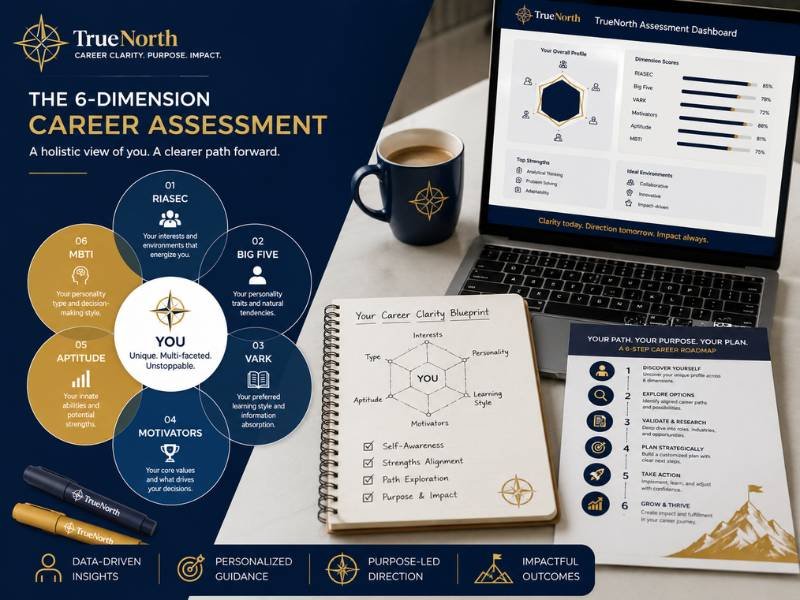
Step 1: Map Your Psychometric Profile Across Six Dimensions
This is the single highest-leverage step in the framework, and the one most graduates skip. You cannot evaluate a career fit if you have not measured the person being fitted. The six dimensions that matter for an Indian graduate are these.
RIASEC (Holland Codes) measures your interest gravity across Realistic, Investigative, Artistic, Social, Enterprising, and Conventional themes. A Realistic-Investigative profile is built for engineering, robotics, applied sciences, and trades. An Enterprising-Social profile thrives in sales, business development, and HR. Your top three codes form your interest fingerprint.
The Big Five measures personality across Openness, Conscientiousness, Extraversion, Agreeableness, and Neuroticism. Conscientiousness is the single strongest predictor of job performance across almost every role. Openness predicts success in creative and research roles. Extraversion predicts comfort in client-facing work.
VARK tells you how you absorb information: Visual, Auditory, Reading-writing, or Kinesthetic. This shapes how you learn on the job, which industries reward your style, and how quickly you can upskill.
Motivators and Values reveals what actually drives you: financial reward, autonomy, recognition, security, impact, intellectual challenge, or work-life balance. A graduate motivated by autonomy will burn out in a hierarchical IT services role, no matter how well-paying.
Aptitude and Skills measures the raw cognitive abilities you can deploy: numerical reasoning, verbal reasoning, spatial intelligence, mechanical reasoning, abstract reasoning. This is the dimension that turns interest into capability.
MBTI adds a final layer on how you process information and make decisions. It is the least scientifically loaded of the six but useful for self-narrative and team fit.
Lyfe Path's 6D assessment combines all six into a 300-question battery, scored against career clusters with documented fit ratios. Each client gets a 1:1 debrief with me where we walk through the data line by line. That debrief is where the data turns into a decision.
Step 2: Audit The Indian Job Market With Real Data
Once you know your profile, you need to know what the market is actually paying for. This is the step where most graduates substitute opinion for data. They ask three relatives, watch a few LinkedIn reels, and call it research.
Build a short list of career clusters that match your top three RIASEC codes. For each cluster, pull three live data points: current hiring volume on Naukri and LinkedIn for your city or target city, salary benchmarks from AmbitionBox or Glassdoor, and the five-year outlook based on World Economic Forum Future of Jobs Report 2025 data, which projects 78 million net new jobs in India by 2030 concentrated in AI, data, green energy, healthcare, and skilled trades. This audit takes a week. It saves years.
Step 3: Calculate The Career Fit Overlap
This is the moment the framework becomes mathematical. For each shortlisted career, score three factors on a 1-to-10 scale: fit (how well it matches your 6D profile), demand (how strong the market is for it), and access (how realistically you can enter it given your current degree, location, and resources). Multiply, do not average. A career scoring 8 fit, 9 demand, and 3 access yields 216, while one scoring 6, 7, and 9 yields 378. The second is the better bet, even though the first felt more aspirational.
Step 4: Run A Skills Gap Analysis
Pick your top two scored careers. For each one, list every skill and certification commonly required in 5 to 10 live job postings. Then compare against what you already have. The gap is your 90-day upskilling roadmap. The Mercer-Mettl 2025 report flagged communication, critical thinking, and creativity as the soft skills graduates are weakest in, with creativity employability scoring just 44.3 percent. If your gap analysis surfaces these, prioritise them; they are the differentiators in interviews.

Step 5: Test Before You Commit
Run two short, cheap experiments before you accept any full-time offer. An informational interview with two professionals already in that field. A two-week unpaid project, internship, or freelance gig in the role. A weekend shadowing day if the field allows it. The point is not to be productive; it is to feel the texture of the work. Most career regrets I see in my counselling practice would have been prevented by ten hours of unromantic, real-world contact with the job before committing to it.
Step 6: Build Your Five-Year Roadmap
End the framework with a written document: year 1 role and target salary, year 2 role and target skill, year 3 specialisation, year 5 leadership or independence milestone. Lyfe Path's full programme produces this as a deliverable, complete with subject and certification recommendations, but you can build a first draft yourself once steps 1 through 5 are done. A written roadmap is the difference between a career and a sequence of jobs.
Key data point: Mercer-Mettl's 2025 study found that graduates from Tier-I institutions in India are only 5 percentage points more employable than those from Tier-III. The college brand matters far less than most parents believe. Fit, skills, and structured decision-making matter far more.
How To Choose A Career After Graduation: Three Real-World Examples
Consider three composite patterns I see repeatedly in Lyfe Path's intake data. They are anonymised, but each one tracks a real client outcome.
The B.Com graduate who thought she had to do an MBA. Her 6D showed Enterprising-Conventional dominance, high Conscientiousness, and a strong aptitude in numerical reasoning. The market audit showed FP&A and corporate finance roles were hiring aggressively in Bangalore and Mumbai. Fit-demand-access scored an 8-8-8 for chartered accountancy via a private firm pathway, compared to 6-5-4 for a generic MBA. She skipped the MBA, articled at a mid-sized firm, and out-earned her MBA-bound peers by year three.
The B.Sc Computer Science graduate who hated coding. His 6D showed Social-Enterprising-Investigative, with high Extraversion. The technical degree was real; the misfit was the role he assumed it locked him into. Product management and pre-sales scored highest. He took an associate product role at a SaaS firm in Pune. The CS degree became an asset, not a cage.
The Arts graduate told she had no future. Her 6D showed Artistic-Investigative-Social, very high Openness, and verbal-reasoning aptitude in the 92nd percentile. The market audit flagged content strategy, UX writing, and brand consulting as hiring strongly. Within six months she was writing for a venture-backed Indian startup at a salary that would surprise her engineering classmates.
The pattern is consistent. A wrong career is rarely a wrong person. It is a missing framework.
If you have been asking yourself how to choose a career after graduation for more than a month, the answer is probably in your data, not your gut.
Take the Lyfe Path 6D Career Assessment and book your 1:1 debrief with me. We will turn six dimensions of data into a single, defensible career decision. Start your assessment here.
A note from Luke
Last December, a B.Tech graduate from Margao walked into my office certain he needed to pivot to UX design. He had been watching LinkedIn reels for three months. His 6D told a completely different story: Realistic-Investigative dominant, low Openness, high Conscientiousness, and spatial-mechanical aptitude in the 95th percentile. UX design would have been a slow, painful misfit. He was not in the wrong field. He was in the wrong niche of the right field.
We mapped him toward industrial automation instead of generic IT services. He signed an offer in robotics QA within ten weeks. That conversation is exactly why I built Lyfe Path around the six-dimension assessment rather than a generic interest quiz. The data does not just point you to a career; it protects you from the career you think you want when the algorithm is doing the deciding for you.
Six Mistakes Graduates Make When Choosing A Career After Graduation
Every framework exists in opposition to the common errors it prevents. Here are the six I see most often in Indian graduates in 2026.
The passion trap. Passion is an output, not an input. Most people develop passion for work they are good at, not the other way around. Choosing on passion alone privileges feeling over data.
The trending field trap. AI, data science, and product management are real and hiring, but they do not fit everyone. A graduate with low numerical aptitude entering data science will struggle through every quarterly review.
The parent-voice trap. Mindler's research found approximately 85 percent of Indian students feel pressured by family to pursue career paths without considering their own strengths. Family advice is well-meaning but built from a smaller information set than the one available to you today.
The peer mimicry trap. If three friends are applying to the same companies, the temptation to apply is enormous. Their fit profile is not your fit profile. You will compete in their tournament and lose, when you could have entered yours and won.
The "I'll figure it out on the job" trap. You will figure something out on the job. You will not figure out fit. By the time you realise the misfit, you are 18 months in with sunk-cost bias working against you.
The "any degree, any job" trap. A few graduates assume their degree dictates their career and shrug into the nearest matching role. Engineering does not lock you out of marketing. Arts does not lock you out of analytics. The Mercer-Mettl 2025 data on cross-disciplinary hiring confirms employers care more about demonstrated skills than degree label.
Your 30-Day Action Plan To Choose A Career After Graduation
If you read nothing else in this article, read this. The framework above becomes useful only when you act. Here is a sequenced 30-day plan that any graduate can run.
- Days 1 to 7: Take a comprehensive multi-dimensional psychometric assessment. The Lyfe Path 6D is one option; whichever you choose, it must cover interests, personality, aptitude, learning style, motivators, and type. Block out a single 90-minute window and complete it in one sitting for cleaner results.
- Days 8 to 10: Get a 1:1 debrief with a qualified counsellor. Read the report alone first, then walk through it line by line with a human who can interpret the scores against career clusters.
- Days 11 to 17: Run the job market audit. Build a spreadsheet with five shortlisted career clusters. For each one, log hiring volume, salary range, top employers, and required skills.
- Days 18 to 20: Score the fit-demand-access matrix and pick your top two careers.
- Days 21 to 27: Run two informational interviews and start one short test project, internship application, or freelance gig.
- Days 28 to 30: Write your five-year roadmap and identify your first 90-day upskilling priority. Begin executing.
Thirty days. That is the time it takes to replace seven years of avoidable wrong turns.
Frequently Asked Questions About Choosing A Career After Graduation
How do I choose a career after graduation if I have no idea what I want to do?
Start with structured self-knowledge before exploring options. Take a multi-dimensional psychometric assessment that measures your interests, personality, aptitude, learning style, and motivators. The combined data points to two or three career clusters that statistically fit you, narrowing the 250-plus career options in India to a manageable shortlist.
What is the best way to choose a career path after college in India?
The most reliable method is a six-step framework: map your psychometric profile, audit the live job market, calculate the overlap between fit and demand, identify your skills gap, test through internships or short projects, and build a five-year roadmap. Skipping the assessment step is the single biggest reason graduates end up in roles they later regret.
How do I know which career suits my personality?
Personality fit is measured most accurately by combining the Big Five traits with the RIASEC interests model and the MBTI types. A high-conscientiousness, introverted, investigative profile suits research, data, and analyst roles. A high-extraversion, enterprising profile thrives in sales, leadership, and client-facing work. The Lyfe Path 6D assessment maps your full profile against career clusters with documented fit scores.
Should I pursue my passion or choose a career with better job prospects?
Neither alone is enough. Passion without market demand leads to underemployment; market demand without fit leads to burnout and high attrition. The right answer lives in the overlap, where your psychometric profile aligns with a career that has real hiring activity in India. That overlap is exactly what a structured framework helps you find.
How long does it take to choose the right career after graduation?
A structured decision can be made in 30 to 45 days. That includes one to two weeks for assessment and debrief, one week for market research, and two to three weeks for one or two short experimental projects or informational interviews. Most graduates lose years not because the process is slow, but because they never start it.
Is a career counsellor really worth the cost for fresh graduates?
A qualified career counsellor pays for themselves many times over when you compare the cost of one assessment to the cost of one wrong career year, which can include lost salary, education loan EMIs, and re-skilling fees. The key is to choose a counsellor who uses validated psychometric tools and gives you a written roadmap, not just generic advice.
Can I change my career after a few years if I choose wrong?
Yes, but each year in the wrong field makes the pivot harder. You accumulate experience that becomes less transferable, your peers in the right field move ahead, and the cost of starting over rises. This is exactly why the decision framework matters most in your first year out of college.
What if my degree doesn't match the career I now want to pursue?
A degree mismatch is rarely fatal in India today. Employers across IT, marketing, finance, design, and consulting hire based on demonstrated skill and certifications more than degree pedigree. The framework still works the same way: assess fit, identify the gap, plug it through targeted courses or projects, then enter the market.

You have read 3,000 words on how to choose a career after graduation. The next step is data, not more reading.
Take the Lyfe Path 6D Career Assessment, sit with me for a 1:1 debrief, and walk out with a written career roadmap built from your actual profile and the actual Indian job market. Begin here. If you would rather talk first, message me directly on WhatsApp from the homepage.
One Last Thing
If you have read this far, thank you. I know how heavy the question of "what next" feels when you are standing at the threshold of working life, with parents asking, peers comparing, and a thousand LinkedIn posts telling you contradictory things. The honest truth is that nobody can hand you the right career. But anyone can hand you a framework that lets you find it for yourself, in less time than you think.
If you want to think through your own decision with someone who has been doing this for a long time, write to me at Lyfe Path. I read every message myself and reply to most. Your data deserves a thoughtful debrief, and your career deserves a real plan.
Luke De Souza
Founder, Lyfe Path
Certified Career Coach · NLP Master Practitioner