

Career Counselling For Parents: 70% Of Families Are Misaligned — How To Guide Your Child Using Data, Not Instinct
If you want to guide your child's career without pushing them into the wrong one, stop deciding from instinct and start deciding from data. Most well-meaning parents pick a "safe" field based on fear and family experience — and a Univariety survey found 70% of Indian parents and children are not even aligned on what that field should be. Your role is to guide, not steer.

Here is the uncomfortable part nobody tells you at the dinner table: your influence over your child's career is enormous, far larger than you think, and that is exactly why it is so easy to get wrong. A study published in the Journal of College Student Development (Creamer & Laughlin, 2005) found that a parent's influence on a career decision can override the influence of teachers, faculty and career counsellors — people who often know more about the field but are simply less trusted than you. You are the loudest voice in the room. The question is whether you are using that voice to guide based on who your child actually is, or based on who you wish they would become.
This guide is not about subjects, streams or which course to pick. It is about something far more useful: how to make career decisions for and with your child the way a professional would — using objective data on interests, personality and aptitude, instead of gut feeling, neighbourhood comparison and the careers that were respectable when you were twenty.
Why The 70% Misalignment Number Matters For Your Child's Career
The Univariety PACE survey (2019–2020) measured something most families never measure: whether parents and children actually agree on the right career path. The answer was a 70% mismatch. Seven out of ten times, the parent has quietly selected a destination the child is not heading towards. This is not a small communication gap. It is the single biggest predictor of a career that gets abandoned later.

Why does this happen so consistently? Because parents and children are usually solving two different problems. The parent is solving for security — a stable income, a recognised qualification, protection from an uncertain economy. The child is solving for identity — who they are, what they are good at, what they can stand to do for forty years. Both are valid. But when the parent's anxiety quietly overrides the child's wiring, the result is a degree that gets completed and a career that gets switched.
The research backs this. Fouad et al. (2016), in a landmark study in the Journal of Career Assessment involving 377 Indian participants, validated that family influence on career decisions is real, measurable and strongly tied to a sense of family obligation. Indian children do not just hear their parents' preferences — they internalise them as duty. That is precisely why a parent who guides badly does lasting damage, and why a parent who guides well gives their child an enormous head start.
The core insight: Your influence is not the problem. Uninformed influence is the problem. The same authority that lets you push a child into the wrong career is the authority that lets you guide them into the right one — if your decisions are anchored in their data instead of your fears.
The Five Instincts That Lead Parents To The Wrong Career Choice
Before you can guide well, you have to recognise the instincts that quietly hijack good intentions. Every one of these comes from love. Every one of them can still steer your child wrong.
1. The Security Instinct
"Engineering or medicine — at least there will always be a job." This was sound advice in 1995. Today, a prestigious degree the student has no aptitude for produces a graduate who switches fields within a few years. A career is only "safe" for the child whose aptitude and motivators actually match it. Safety lives in fit and follow-through, not in the name of the degree.
2. The Mirror Instinct
"It worked for me, so it will work for them." Your career success was built on your wiring, your era and your job market — none of which your child inherited intact. What fits you may bore or break them.
3. The Trend Instinct
"AI and data science are booming, push them there." Chasing a trending field without checking whether the child has the underlying aptitude is how families burn years and lakhs. By the time a four-year degree finishes, the trend has often moved.
4. The Comparison Instinct
"The neighbour's daughter topped in maths, why can't you?" Comparison is what Theodore Roosevelt called the thief of joy, and in career terms it is the thief of fit. Your child's path has to be built from your child's data, not someone else's report card.
5. The Unlived Ambition Instinct
This is the quietest and most powerful one. The career you wish you had taken, the freedom you never got, the path your own parents blocked — these leak into the choices you make for your child without you noticing. We will come back to this one, because it is the instinct that nearly derailed a family I worked with last year.
Instinct Versus Data: What Each One Actually Tells You
The difference between guiding and steering comes down to what information you are acting on. Here is the honest comparison.
| Decision Factor | Parental Instinct Says | Psychometric Data Shows |
|---|---|---|
| Interests | "They like computers, so IT." | Whether the interest is investigative, creative or social — and which careers actually use it. |
| Personality | "They are shy, so no sales." | How traits like conscientiousness and openness predict fit across dozens of roles. |
| Aptitude | "They are weak in maths." | Specific verbal, numerical, spatial and reasoning strengths that map to real fields. |
| Motivators | "Money matters most." | Whether the child is actually driven by income, autonomy, security or recognition. |
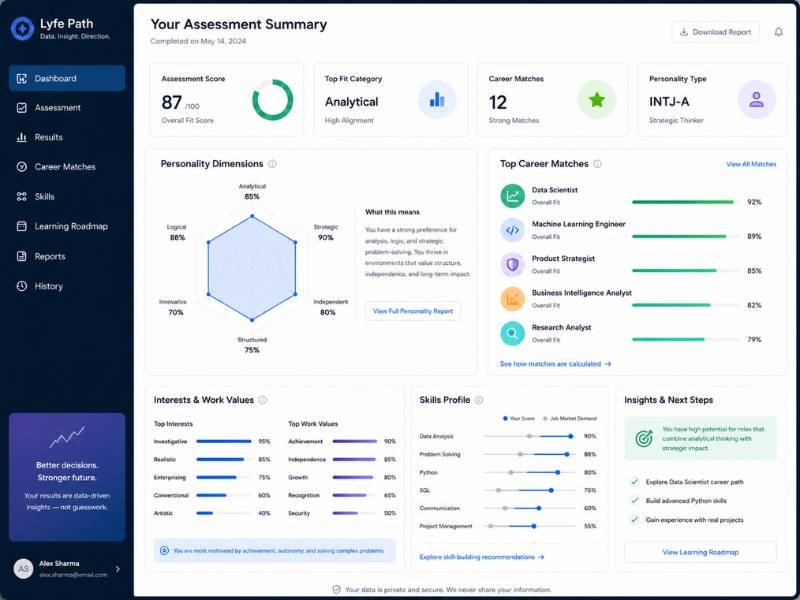
Notice the pattern. Instinct gives you a one-line verdict. Data gives you a map. This is the entire premise behind Lyfe Path's 6-dimension assessment, which measures interests (RIASEC), personality (Big Five), learning style (VARK), aptitude, motivators and personality type across a 300-question battery. It is not a quiz that spits out a job title. It is the evidence base that lets you stop arguing about opinions and start working from facts.
If you have already picked a career for your child in your head, here is a fair test: do you actually know their top motivator, or are you guessing? Lyfe Path's 6-dimension assessment answers that question with data, followed by a 1:1 debrief where I walk you and your child through what it means.
Why "Just Let Them Decide" Is Equally Bad Advice
If you have read this far, you might conclude the answer is to step back entirely and let your child choose. That is the opposite mistake. A fifteen-year-old cannot evaluate options they have never been exposed to, in a job market they do not understand, with a self-awareness that has not formed yet.
The data is blunt about this. A study of higher-secondary students across Chennai, Coimbatore and Bangalore (published in the International Journal of Literacy and Education, 2024) found that an overwhelming majority of students were tentative — neither decided nor confidently undecided about their careers. Left alone, most teenagers do not find clarity. They find paralysis, then they default to whatever their friends are doing or whatever sounds impressive.
So neither extreme works. Deciding for them creates the 70% misalignment. Abandoning them creates drift. The professional approach — and the one that actually protects your child — is what researchers Thomas and Joseph (2024), in the International Journal of Indian Psychology, called "informed parental influence." You stay involved, you bring perspective and reality, but the direction is anchored in objective data about the child, not your assumptions about the world.
Luke's Story
A father walked into a debrief last August convinced his son was throwing his future away. The boy had refused a CA articleship to start a podcast, and the father was, in his words, watching a good career die. We pulled up the son's 6-dimension report. His Investigative scores were strong and his verbal-linguistic aptitude was high — so the father was partly right about the analytical strength. But his Motivators told a different story: Autonomy sat right at the top, far above Income.
Here is the thing — showing the father his son's data did not change his mind. What changed it was something else. I asked the father to take a five-minute Motivators check himself. His top score was also Autonomy. He went quiet for a long minute, then said, "I never got to choose. I don't want him to feel that." That was the moment the whole conversation turned. The career mismatch on the table was never really about the son. It was the father's own unlived choice, projected forward a generation. The data did not just describe the child — it gave the father a mirror. Ever since, that is how I run these debriefs: I bring the parent's wiring into the room too, because the instinct steering the decision is usually theirs, not the child's.

A Step-By-Step Action Plan For Parents
Here is a structured way to guide your child's career decision without falling into instinct traps. This works whatever your child's age, stream or interests.
- Separate your anxiety from their decision. Before any conversation, name what you are afraid of — financial insecurity, social judgement, your own regrets. You cannot guide cleanly until you know which of your fears are doing the talking.
- Get objective data before you get opinionated. Run a multi-dimensional psychometric assessment that measures interests, personality, aptitude and motivators. Decide nothing until you can see the map, not just the one-line verdict.
- Take the assessment yourself. Knowing your own motivators reveals which of your "suggestions" are really about you. This single step prevents the most common form of misalignment.
- Replace instructions with questions. Instead of "you should do engineering," try "your aptitude report shows strong spatial reasoning — what careers do you think use that?" Let the child reason from their own data.
- Pressure-test the dream, do not crush it. If your child wants something unconventional, check it against the data instead of rejecting it. An unconventional choice backed by real aptitude beats a safe choice with none.
- Fund the exploration, not just the destination. Internships, shadowing, short courses and conversations with people in the field cost little and prevent expensive five-year mistakes.
- Sit through the 1:1 debrief together. A trained counsellor turns a report into a roadmap and acts as the neutral third voice, so the hard truths land as data rather than as you versus your child.
How To Have The Conversation Without It Becoming A Fight
The reason career talks turn into battles is that opinions feel personal and rejecting an opinion feels like rejecting the person. Data does not work that way. When a recommendation comes from an assessment instead of from you, your child cannot read it as criticism, and you cannot read their resistance as defiance. You are both now looking at the same map and solving the same problem.
This is the quiet superpower of a structured process. It moves the difficult conversation off the dinner table — where it is loaded with history, comparison and emotion — and onto a report, where it is just information. Your job shifts from being the decision-maker to being the perspective-keeper: the one who explains what the job market really looks like, who funds the exploration, and who holds steady while the child figures out their direction.
The conversations that go well are the ones where neither parent nor child is guessing. Lyfe Path's Career Clarity Programme gives your family the full 6-dimension report, a career fit roadmap, and a personal debrief where I sit with both of you and translate the data into a plan you can both stand behind.
Frequently Asked Questions About Career Counselling For Parents
What is the right age to start career counselling for my child?
The strongest window is Class 8 to Class 10, before stream selection locks your child into a narrow path. At this stage a psychometric assessment can map interests, aptitude and personality early, so subject choices are made on evidence rather than guesswork. It is never too late, but earlier means fewer expensive course corrections later.
Should I choose my child's career or let them decide?
Neither extreme works. Choosing for them breeds resentment and disengagement; leaving a 15-year-old entirely alone leaves them overwhelmed by options they cannot yet evaluate. The healthy middle is informed guidance: you bring perspective and the job-market reality, the assessment brings objective data on fit, and the final direction is shaped together.
My child wants an unconventional career. What should I do?
Test the fit before you approve or reject it. An unconventional choice driven by genuine aptitude and matching personality is far more likely to succeed than a safe choice the child has no inclination for. A 6-dimension assessment shows whether the interest is a passing phase or a real strength worth backing.
Are psychometric career assessments reliable for teenagers?
Validated instruments measuring interests, personality and aptitude are well-established research tools, and family influence on Indian career decisions has been studied with the same scientific scales (Fouad et al., 2016, Journal of Career Assessment). Reliability depends on using a multi-dimensional battery and a trained debrief, not a free single-page quiz. One number on a screen is not a result.
How is career counselling for parents different from counselling for students?
Counselling for students focuses on discovery. Counselling for parents focuses on alignment, expectation management and decision-making under pressure, because parents carry financial stakes, family reputation and their own unlived ambitions into the room. A good process gives the parent the data and the language to support rather than steer.
What if my child has no idea what they want to do?
That is normal, not a warning sign. Research on Indian higher-secondary students found the overwhelming majority were undecided about their career direction. A structured assessment turns a blank wall into a shortlist of evidence-based options your child can actually explore, which is far more productive than pressuring them for an answer they do not have.
Is engineering or medicine still a safe career choice in India?
A field is only safe for the child whose aptitude and motivators match it. A degree in a prestigious field that the student has no inclination for often ends in switched careers, low engagement and wasted years. Safety comes from fit and follow-through, not from the label on the degree.
How do I support my child without pressuring them?
Shift from giving instructions to asking questions, and let neutral data carry the hard conversations. When a recommendation comes from an assessment rather than from you, it stops being a battle of wills and becomes a shared problem to solve. Your job is to fund the exploration and hold the perspective, not to pick the answer.

A Final Word From Luke
If you have read this far, you are already a more thoughtful parent than most — because most never question the instinct at all. I want to leave you with the single idea that matters most: your influence is not something to apologise for or switch off. It is the most powerful tool your child has. The only question is whether you point it using data about who they are, or using fear about what might go wrong.
I have watched families turn a years-long standoff into a shared plan in the space of one honest debrief — usually the moment the parent realises the decision was never really about the child. That shift is what I do this work for. If you are carrying a career decision for your child right now and you are not sure whether you are guiding or steering, I would genuinely love to help you find out.
Thank you for giving this your time and attention — it says a great deal about the kind of parent you are. If you would like to talk it through personally, reach out anytime. I read every message myself.
— Luke, Lyfe Path