

Career Counselling for Freshers: How to Land Your First Job and Negotiate a Salary That's 18% Higher
The short answer: career counselling for freshers works because it replaces guesswork with data. Most new graduates lose money, time, and momentum in their first year — not because they lack skills, but because they don't know which roles fit them, which offers to take, or that they're allowed to negotiate at all. This guide fixes all three.

Why Freshers Are Losing Before They Even Start
India's job market in 2025 presents one of the starkest paradoxes in the world: 72% of employers intend to hire freshers, yet 83% of new engineering graduates remain jobless or without even an internship offer. The degrees exist. The jobs exist. The gap between them is strategic — and that's exactly where career counselling lives.
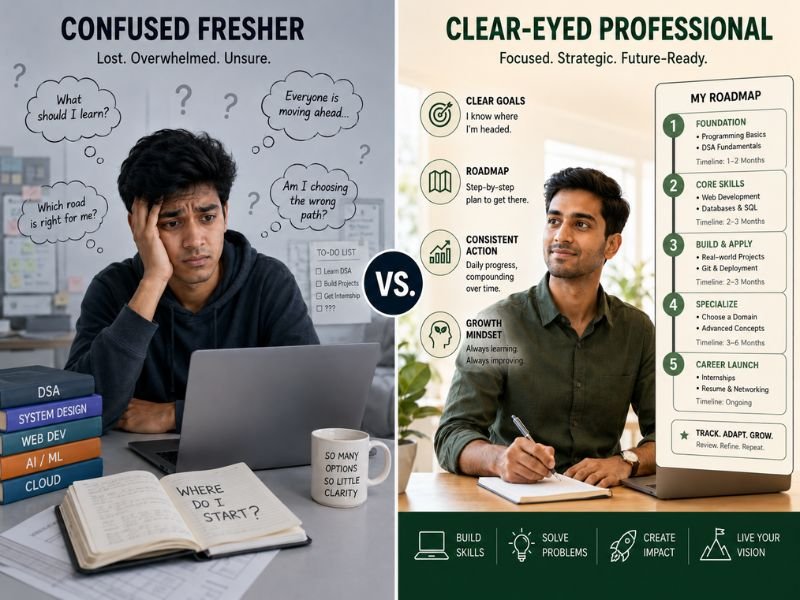
The problem isn't competition. It's confusion. Most freshers enter the job market without a clear understanding of what kind of environment they work best in, what their actual strengths are beyond their CGPA, or what's negotiable in an offer letter. They apply to everything, accept the first offer out of relief, and realise six months in that the role was never right for them.
The data is unambiguous: Candidates who negotiate their salary receive an average of 18.83% more than those who accept the first offer — with some achieving increases of up to 100%. Yet 55% of job seekers never attempt to negotiate at all, even though 73% say salary is their top priority when evaluating a role.
Source: Compiled research from Harvard Business School, Pew Research Center, and National Bureau of Economic Research (2024–2025), via The Interview Guys.
Career counselling for freshers is the structured process that closes this gap. It starts with understanding who you are — your personality type, interest profile, learning style, core motivators, and cognitive strengths — and then builds a precise job search and negotiation strategy around that data. It's the difference between reacting to the market and positioning yourself within it.
The Real Problem With How Freshers Search For Jobs
When a fresh graduate opens a job portal, the typical process looks like this: filter by qualification, scroll through results, apply to anything that seems vaguely relevant, and wait. This approach is emotionally exhausting and strategically ineffective — because it treats all roles as equal and the applicant as interchangeable.
The fresher job market in India in 2026 has shifted significantly. Companies are no longer running mass campus drives across mid-tier colleges. They're hiring through specialised assessments, internship-to-hire pipelines, and hackathons. The model puts pressure on students to know what they're targeting before they approach the market — not after the rejections start.
Three patterns consistently emerge in career counselling sessions with freshers:
- Role mismatch: Taking any available job rather than the right category of job — leading to early exits and gaps in the CV that are hard to explain.
- Offer blindness: Accepting an offer without understanding the structure — CTC vs. in-hand, variable components, appraisal timelines — and leaving money on the table from day one.
- Decision outsourcing: Letting family opinion, peer pressure, or brand name drive the choice rather than personal data about strengths and fit.
None of these problems are fixed by a better resume. They're fixed by a clearer understanding of yourself — which is what psychometric assessment delivers.
What Career Counselling For Freshers Actually Does
A well-structured career counselling engagement for freshers is built around one question: given who you are, what does the right first job look like?
At Lyfe Path, we run every fresher through a 6-dimension psychometric battery before we advise anything. The six dimensions are:
1. RIASEC Interest Profiling
Holland's RIASEC model — Realistic, Investigative, Artistic, Social, Enterprising, Conventional — maps your interest profile against career environments. A fresher with a strong Enterprising-Conventional profile will thrive in sales operations, finance, or consulting. That same person in a creative or purely technical role will stagnate, regardless of their degree. Knowing your RIASEC code before your first job search changes the entire list of roles you target.
2. Big Five Personality Assessment
The Big Five — Openness, Conscientiousness, Extraversion, Agreeableness, Neuroticism — predicts job performance more reliably than academic scores or interview performance. A high-Conscientiousness, low-Openness profile does not belong in a startup's ambiguous "growth associate" role. That profile belongs somewhere with structure, clear KPIs, and a defined appraisal cycle. Getting this wrong is a career setback that takes 18 months to recover from.
3. VARK Learning Style
Visual, Auditory, Read/Write, or Kinesthetic — your dominant learning style determines how fast you'll onboard in a new role, how you absorb training, and how you'll communicate your value to a manager in your first 90 days. Most freshers don't know which mode they favour. Most managers don't ask. The mismatch costs both parties time and performance.
4. Motivators and Values Mapping
What actually drives you? Financial security, recognition, autonomy, impact, mastery, affiliation? Your core motivators determine whether you'll stay in a role past year one. A fresher whose primary motivator is financial security and recognition will not be happy in a mission-driven NGO role — even if the work is meaningful to others. Mapping motivators prevents the "I thought I'd love this job" conversation that happens far too often at the twelve-month mark.
5. Aptitude and Skills Assessment
Raw cognitive strengths — numerical reasoning, verbal ability, logical analysis, spatial thinking — tell us where your natural processing speed is highest. These don't predict intelligence; they predict which categories of tasks you'll find effortless vs. draining. A fresher with high verbal and low numerical aptitude does not belong in a financial modelling role, regardless of their accounting degree.
6. MBTI Personality Type
The Myers-Briggs Type Indicator adds a layer of interpersonal and decision-making style. How does this person process information — sequentially or globally? How do they restore energy — through people or solitude? Do they prefer closure or flexibility? In a team environment, knowing your MBTI type helps you understand your own tendencies before a manager has to point them out.
If you're a fresher reading this and you don't yet have clear answers to the questions above — your interest profile, your personality type, your motivators, your strongest cognitive dimensions — you're making one of the biggest decisions of your professional life without the data you need.
Take Lyfe Path's Career Assessment → Get your complete 6-dimension profile, a career cluster map, and a role shortlist built around who you actually are. Start for ₹500.
How to Build a First Job Strategy That Works
Once you have your psychometric data, job searching stops being a volume game and becomes a targeting exercise. Here's the framework we use with every fresher client at Lyfe Path.
Step 1: Build Your Target Role List
Based on your RIASEC code and Big Five profile, identify the categories of roles — not specific job titles — that match your working style. A Social-Enterprising profile with high Extraversion belongs in roles involving persuasion, relationship-building, or leadership: BD, sales, recruitment, consulting, training. An Investigative-Conventional profile with high Conscientiousness belongs in analytical or process-driven roles: data analysis, finance, operations, quality. Build a list of 5–8 role categories before you open a job portal.
Step 2: Identify Your Market Range Before You Apply
Before a single application goes out, research the salary range for your target role in your target city. Use AmbitionBox, Glassdoor, and LinkedIn Salary Insights. For freshers in India in 2026, the broad range is ₹3–6 LPA across sectors, with AI and data science roles stretching significantly higher. Know your range. Write it down. This is your negotiation anchor.
Step 3: Build a Targeted Profile, Not a Generic Resume
Your resume should speak to one role category, not attempt to appeal to everyone. Lead with a two-line profile statement that names your strongest psychometric-backed strength and your target function. Emphasise relevant projects, internships, or certifications that demonstrate aptitude in that function — even if your degree is unrelated. Recruiters in 2026 are screening for skills first, degrees second.
Step 4: Apply to Fewer Roles, Better Matched
Mass-applying to 200 roles produces worse outcomes than 30 targeted applications to roles that genuinely match your profile. Each application should be customised to the job description with specific language that mirrors the role requirements. Use your RIASEC and strengths data to write cover emails that lead with your relevant capability — not your enthusiasm for the company.

Salary Negotiation For Freshers: The Complete Framework
Most freshers believe the salary printed on the offer letter is fixed. It isn't. And the belief that it is costs the average fresher anywhere from ₹30,000 to ₹80,000 in year one alone — money that compounds in every appraisal cycle that follows, since most increment calculations use your existing salary as the base.
First: Understand The Offer Before You Respond
When an offer comes in, ask for the full offer letter with a salary breakup before you say yes or no. Every offer letter in India will have:
- Basic Salary: The base. Usually 40–50% of CTC. Everything else is derived from it.
- HRA (House Rent Allowance): Tax-exempt up to a limit. Usually 40–50% of basic.
- Special Allowance: A catch-all component that varies by company.
- PF Contribution: 12% of basic, deducted from your in-hand. Employer matches it — but it's included in your CTC.
- Variable Pay / Performance Bonus: Often 10–20% of CTC. Paid out quarterly or annually, subject to performance. Never count this as guaranteed income.
- Gratuity: Typically 4.81% of basic. Only payable after 5 years of service.
Once you understand the structure, you know where the room to negotiate sits. Variable pay, joining bonus, and allowances are almost always more flexible than fixed basic — especially for freshers entering mid-sized companies.
The Negotiation Call: What to Say
This is the conversation most freshers are terrified of. Here's the framework that works:
- Acknowledge the offer genuinely: "Thank you so much for the offer — I'm genuinely excited about the role and the team."
- Anchor to market data: "Based on my research for this role in [city] — using AmbitionBox and Glassdoor — the range sits between ₹X and ₹Y. I was hoping we could explore something closer to ₹[your target]."
- State your value point: Refer to a specific internship result, certification, or skill that's directly relevant. "I also bring [specific capability], which I think will help with [specific part of the role]."
- Stay open: "I'm flexible on structure — if the base isn't movable, I'm open to discussing a joining bonus or a revised variable component."
- Set a timeline: "Could you let me know by [date]? I want to make a considered decision."
What can freshers actually negotiate?
In large MNCs and established companies: base salary (within a band), joining bonus, and start date. In startups and mid-sized firms: almost everything — including role scope, title, remote flexibility, and variable structure. In government PSUs and mass campus hiring: very little. Know your context before you call.
What To Do If They Say No
If the company says the number is fixed, respond with: "I completely understand. Could you tell me more about the appraisal cycle and what a strong performer in this role would typically see at the 6-month and 12-month mark?" This does two things: it shows you're thinking long-term, and it gets you the information you need to decide whether the role's growth trajectory justifies accepting the offer as-is.
If the answer to that question is also unsatisfying, that is data. Use it.

How to Evaluate A Job Offer Beyond the Salary
Salary is a single number. A job offer is a contract for how you'll spend 2,000+ hours of your life in the next twelve months. Here's what else to evaluate:
The Appraisal Structure
How often? Based on what metrics? Who decides? A role with a clear, performance-linked appraisal at 6 and 12 months is worth more than a role with a flat "annual review" that's tied to company-wide budgets. Ask specifically: "What does a high performer in this role achieve in year one, and how does that translate to compensation at appraisal?"
Your Reporting Manager
The most underrated factor in a fresher's first year is who they learn from daily. Ask for a second conversation with your direct manager before you accept. Notice: Do they explain things clearly? Do they seem invested in developing people? Do they take credit or give it? Your first manager shapes your professional identity more than any training programme will.
Role Scope in Year One
Are you doing the job, or shadowing someone doing the job? A title that sounds impressive but involves six months of data entry is not a growth role. Ask what a typical week looks like in month three — not week one. The answer tells you everything about whether this role will accelerate or stall your career.
Skill Transferability
Will the skills you build in this role be valued by other employers — or only by this company? Company-specific tools, proprietary platforms, and narrow vertical expertise can trap you. Skills like data analysis, stakeholder communication, project management, and process design are transferable across sectors and compound across every role that follows.
From Luke's desk — Rohan's story
Rohan Mehta came to me three weeks after his convocation, a 22-year-old B.Com graduate from Pune clutching two offer letters he didn't fully understand and a WhatsApp full of "bro just take the MNC one" advice from friends. He wasn't confused about which offer to pick. He was confused about who he was professionally — and that's a completely different problem.
As we worked through our sessions, a very clear picture emerged. Rohan was someone who thrived in structured, goal-oriented environments. He was methodical, detail-driven, and quietly competitive — the kind of person who keeps score even when no one's watching. And when we dug into what actually motivated him, financial security and recognition came up again and again. Not as shallow desires — as genuine, deeply held drivers.
And yet, one of the offers on the table was for a scrappy startup with no fixed appraisal cycle and equity he couldn't explain to his own father. I asked him why he was even considering it. He said, "It sounds cool." That was the whole answer.
We spent time mapping his actual strengths — analytical thinking, attention to detail, persuasion in one-on-one settings — against both roles. The MNC offer was in sales operations at ₹3.2 LPA. The startup was a "growth associate" role at ₹2.8 LPA with "unlimited upside." His gut said MNC. Everyone else's opinion was muddying that. Once we cleared the noise, the decision made itself.
Then we got into salary negotiation — which most freshers treat like a grenade they're afraid to pull the pin on. Rohan assumed the number on the offer letter was fixed. It isn't. We broke down exactly how to read an offer — the difference between CTC and in-hand, what each component meant, and where room to negotiate usually sits. Then we worked on what he'd actually say when he called HR back. Not a script — a framework. Acknowledge the offer, express genuine enthusiasm, anchor to market data, ask professionally.
He called me two days later. They moved from ₹3.2 to ₹3.6 LPA, added a joining bonus, and he started the following Monday.
What I remember most is what he said at the end of our last session: "I didn't know I was allowed to ask."
That's the thing nobody tells freshers. You are allowed to ask. You just need to know how.
Your First-Job Action Plan: 8 Steps From Graduation to Offer
- Complete a psychometric assessment covering your interests, personality, motivators, learning style, and aptitude — before you apply anywhere. This is your map. Everything else navigates from it.
- Build your target role list based on your profile. Five to eight role categories that match who you are, not what's trending on LinkedIn that week.
- Research your market range for those roles in your target city. Use AmbitionBox, Glassdoor, and LinkedIn Salary. Write your target number down.
- Build a targeted resume with a two-line profile statement, role-specific keywords, and evidence of relevant capability — even from academic projects or internships.
- Apply with precision, not volume. Twenty well-crafted applications to matched roles outperform two hundred spray-and-pray submissions every time.
- Prepare your negotiation framework before any offer arrives — so you're not making it up on a phone call under pressure. Know your anchor, your value point, and your flexibility.
- Read every offer letter in full before you respond. Understand the CTC breakup, the variable component, the appraisal cycle, and the deductions. Ask for 48 hours if you need them.
- Negotiate professionally. Acknowledge, anchor, ask. If the base won't move, ask about a joining bonus or revised variable. If nothing moves, ask about the appraisal timeline. Then decide.
If you've been approaching your job search by instinct — scrolling portals, applying broadly, hoping something sticks — this is the moment to step back and build the strategy your first job deserves.
Lyfe Path's career assessment gives you a complete 6-dimension psychometric profile, a career cluster map built around your strengths and motivators, a personalised role shortlist, and a 1:1 debrief session where we build the strategy together.
Start your Career Assessment here → Entry-level profile from ₹500. Full programme with sessions and year-long support from ₹4,500.
Frequently Asked Questions
Should freshers negotiate salary in India?
Yes — and most don't, which is exactly why they should. Research from 2024–2025 shows that candidates who negotiate receive an average of 18.83% more than those who accept the first offer. Freshers can negotiate using internship performance, certifications, market benchmarks, and competing offers as leverage. The worst a company can say is no.
What is career counselling for freshers?
Career counselling for freshers is a structured guidance process that helps new graduates identify the right job roles based on their personality, strengths, and motivators — and then build a strategy to pursue and negotiate those roles effectively. It goes far beyond resume advice. A good counsellor uses psychometric tools to map who you actually are against what the market is hiring for.
How do I choose between two job offers as a fresher?
Don't choose on salary alone or on what sounds impressive. Evaluate each role against three filters: does this environment match how I work best, does this role align with my core motivators, and what does year-three look like from this starting point? Psychometric data gives you a clear lens for this decision — gut feel and friends' opinions rarely do.
What is the difference between CTC and in-hand salary for freshers?
CTC (Cost to Company) is the total annual amount the company spends on you — it includes your base salary, provident fund contributions, insurance, variable pay, and bonuses. In-hand salary is what actually lands in your bank account each month after deductions. For a fresher with a CTC of ₹4 LPA, in-hand is typically ₹26,000–₹30,000 per month depending on the structure. Always ask for the offer letter breakdown before accepting.
Is the first job the most important career decision a fresher makes?
Not always — but it sets the trajectory. Your first role shapes your initial skill development, professional network, and salary base. Because future employers use your current salary as an anchor point, a well-negotiated first offer compounds significantly over the next five years. The bigger risk is taking a role that doesn't match your personality or strengths, which leads to underperformance, low confidence, and early exits.
How do I answer 'What are your salary expectations?' as a fresher?
Research the market range for your role in your city using AmbitionBox, Glassdoor, and LinkedIn Salary. Then give a range with your target at the lower end: "Based on the market for this role in [city], I'm looking at something in the range of ₹X to ₹Y. I'm flexible given the full package and growth path." This keeps you anchored above the minimum without appearing inflexible.
What should freshers look for beyond salary in a job offer?
Look at the appraisal cycle and frequency, learning and development budget, reporting structure, role scope in year one vs year two, and whether the skills you build are transferable or company-specific. A ₹50,000 higher salary in a dead-end role is worth less than a ₹30,000 lower offer with a structured growth ladder.
How does a psychometric assessment help freshers with career decisions?
A psychometric assessment maps your personality type, interest profile, learning style, motivators, and cognitive strengths — and cross-references them against career environments. For freshers, this removes the biggest obstacle to a good decision: not knowing yourself well enough. Instead of choosing careers based on salary lists or peer pressure, you're choosing based on data about how you actually think, work, and thrive.

A Final Word From Luke
The freshers I work with are not short on ambition or ability. What they're short on is a framework — a structured way to understand themselves, read the market, and make decisions under pressure. The 6-dimension assessment we run at Lyfe Path was built specifically to give freshers that framework, so that conversations about offer letters and role choices are grounded in data, not driven by anxiety.
I've watched graduates negotiate their way from ₹3.2 to ₹3.6 LPA, add a joining bonus, and start their career with confidence rather than relief. I've watched freshers turn down the "cool" startup and choose the structured MNC — and thank themselves for it eighteen months later. These outcomes don't happen by accident. They happen when you know yourself well enough to make the right call, and when someone has taken the time to show you how.
If you're a fresher reading this and you're still figuring it out — that's completely normal, and it's exactly where I come in. Reach out to us at lyfepath.in, take the assessment, or message us on WhatsApp. The best time to get this right is before you accept that first offer.
Thank you for taking the time to read this — I genuinely hope it gives you one clearer step forward. Here whenever you need guidance.
— Luke De Souza, Lyfe Path
Certified Career Coach | Certified Career Analyst | NLP Master Practitioner