

70% Of Indians Are Confused About Their Careers — Here's Exactly When You Need A Career Counselor
You need a career counselor when the same question has circled your mind for weeks and you are no closer to an answer. That is the threshold. Not when you have failed. Not when you have run out of options. When the loop does not break on its own — that is when structured, data-backed guidance stops being optional and starts being the practical next step. The seven signs below will tell you exactly where you stand.

Why Most People Wait Too Long — And What It Actually Costs Them
An Edumilestones survey conducted across 2023 and 2024 found that 70% of Indian students and professionals are confused about their careers. That is not a fringe statistic — it is a majority. Yet India has fewer than 10,000 trained career counsellors for a population where guidance is needed at a ratio of roughly 1:3,000, against the globally recommended 1:250 (Infigon Futures, 2024).
The result is predictable: people do not seek professional guidance because the infrastructure has never made it feel normal. Career counselling in India is still treated as something you do in a crisis, not something you do strategically. A separate survey by Indeed found that 40% of working professionals in India are unhappy in their jobs — most of them having never had a structured conversation about whether the role they entered was the right fit to begin with.
The cost of waiting is not dramatic. It rarely announces itself. It shows up as vague dissatisfaction you cannot quite name. As another year in a degree you are not sure about. As a promotion that feels hollow. As a return to work after a break that never quite gets off the ground. The waiting does not just cost time. It costs the quieter thing — the confidence and direction that comes from being heard at the right moment.
The data at a glance:
70% of Indian students and professionals report career confusion (Edumilestones, 2023–24). Over 93% of Indian schools have no dedicated career counsellor (iDreamCareer, 2024). 40% of working professionals in India are unhappy in their current roles (Indeed). India needs 1.4 million more trained career counsellors to meet international standards — and currently has fewer than 10,000.
7 Signs You Need A Career Counselor Right Now
These are not abstract warning signs. Each one corresponds to a specific pattern that shows up repeatedly in career counselling work — situations where unassisted reflection reliably fails to produce clarity, and where structured, data-backed guidance produces measurable change.
- You have been asking the same question for weeks without moving closer to an answer. Career decisions involve too many interacting variables — interests, aptitude, personality, job market realities, values — for unstructured thinking alone to resolve. When the loop does not break, it is not because you are not smart enough. It is because the problem requires a different process.
- You are about to make a high-stakes decision with no data. Stream selection in Class 9 or 10. Choosing a postgraduate programme. Accepting a lateral role. These are inflection points. Making them on instinct, family pressure, or peer comparison is how misalignment compounds over years. A career counselor brings psychometric data, market information, and a structured framework to these exact moments.
- You are unhappy in your current role but cannot identify why. This is one of the most common presentations in career counselling. The job is not terrible. The pay is acceptable. But something is persistently wrong and you cannot put a name to it. That unnamed thing is almost always a values mismatch, a personality-role mismatch, or a gap between your motivators and what the role actually rewards. Psychometric assessment surfaces it clearly.
- Someone else is making the decision for you — and you are letting them. In India, family input on career decisions is normal and often well-intentioned. But when a parent's preference, a relative's suggestion, or peer comparison is the primary driver of your choice, you have outsourced a deeply personal decision to people who do not have access to your internal data. A career counselor gives you the information and language to make — and defend — your own call.
- You have chosen the wrong stream or degree and do not know what to do next. This is not a dead end. It is one of the most solvable problems in career counselling. Most fields allow for lateral moves, bridging qualifications, or dual-skill combinations that redirect a career without requiring you to start over. But the path needs to be mapped — and mapping it requires knowing what you have, what you want, and what the job market actually rewards.
- You are returning to work after a break and do not know where to re-enter. Women returning to work after a career break, professionals re-entering after illness or relocation, people transitioning from one sector to another — all of these require more than a revised CV. They require a clear read on which of your skills transfer, which gaps need bridging, and where the market has moved since you were last active in it.
- You feel like your career and your personality are pulling in opposite directions. This is the clearest signal of all. When the work you do every day feels fundamentally misaligned with how you think, what you value, and what energises you — that is not a motivation problem. That is a fit problem. And fit problems are precisely what psychometric career assessment is designed to diagnose.
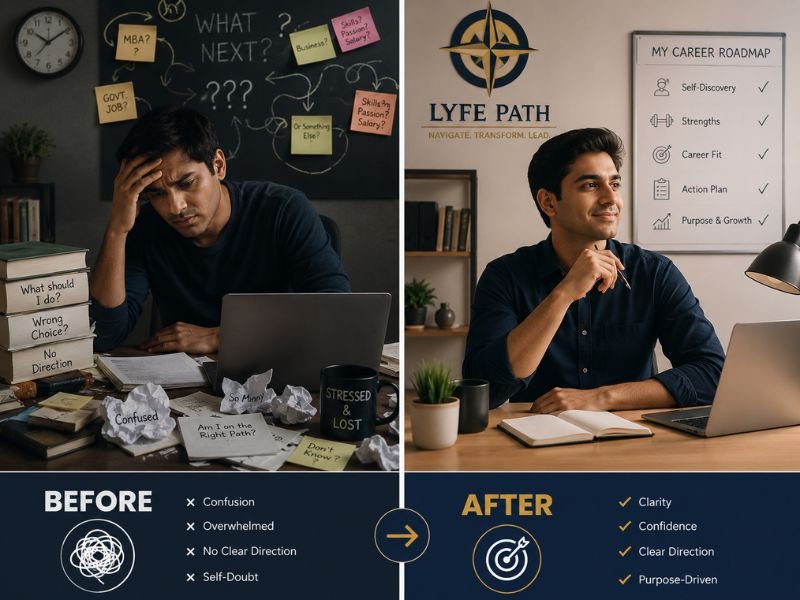
If you recognise yourself in two or more of those signs, the answer is probably already in your data — not in another round of thinking about it. Take Lyfe Path's psychometric assessment and get a clear picture of where you are and where you actually fit.
What Happens In A Career Counselling Session — And What You Actually Get
One reason people delay seeking career counselling is a vague picture of what it involves. The assumption is often that it will be a conversation — someone asking you what you enjoy and reflecting it back. Done well, career counselling is nothing like that.
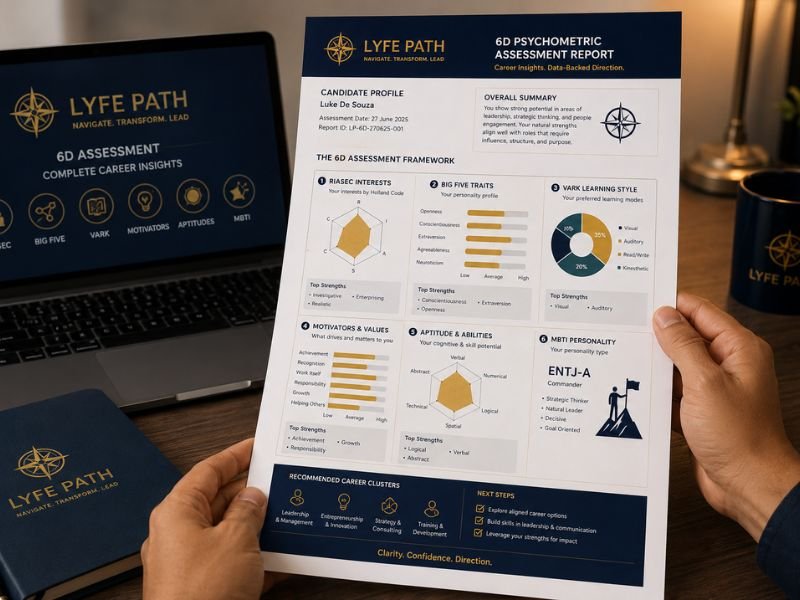
A rigorous process begins before the first conversation. At Lyfe Path, every engagement starts with a 300-question psychometric battery covering six dimensions: RIASEC (career interests), Big Five personality, VARK learning style, aptitude and skills, motivators and values, and MBTI type. The result is a personalised Career Report of 30-plus pages — covering Career Cluster Mapping, Subject Recommendation, Career Fit Scoring, Gap Analysis, and an Education and Career Roadmap.
The report is not sent and left with you. Luke debriefs every client personally in a 1:1 session. That is the part that matters most: a structured conversation where the data is explained, questions are answered, and the roadmap is built together in real time. What distinguishes this from the brief school-level "have you considered engineering?" conversation is the depth of the diagnostic. The output is specific, actionable, and grounded in who you actually are — not who a well-meaning adult thinks you should be.

How Psychometric Data Changes The Career Conversation
The limitation of most career guidance in India is not intent — it is information. Well-meaning parents, teachers, and relatives give advice based on what they know: the careers they have seen, the courses they are familiar with, the industries that were stable when they were making their own choices. That pool of information is always narrower than the actual landscape of options available to you today.
Psychometric assessment changes the conversation because it introduces a different kind of data: information about you. Not your grades. Not your rank. Not what your peer group is doing. Information about how you process the world, what actually motivates you, where your natural aptitudes sit, and which work environments will allow you to perform at your best over time.
The six dimensions measured in a Lyfe Path assessment work together rather than independently. A high RIASEC score in Investigative careers means something different for a person with an introverted Big Five profile and strong analytical aptitude than it does for someone who scores Extroverted with high Social interest but weak quantitative aptitude. The interaction between dimensions is what produces specific, defensible career direction — not any single score in isolation.
What a 6-dimension assessment covers:
RIASEC — career interest clusters (Realistic, Investigative, Artistic, Social, Enterprising, Conventional). Big Five — personality factors that predict job performance and work environment fit. VARK — how you learn, which determines how you will grow in any role. Aptitude and Skills — where your natural abilities sit across verbal, numerical, spatial, and logical domains. Motivators and Values — what actually drives you, beyond what you say in an interview. MBTI — cognitive and social style, relevant to team fit and leadership potential.
The Difference Between Career Counselling And Career Coaching
These terms are used interchangeably in India, but they describe different things. Understanding the distinction helps you find the right kind of help for where you actually are.
Career counselling is diagnostic and foundational. It is most useful before a major decision — stream selection, degree choice, career pivot, re-entry. It uses structured assessment to build a data-backed picture of who you are and where you fit. The output is a roadmap.
Career coaching is execution-focused. It is most useful when you already know your direction and need help getting there — interview preparation, CV writing, LinkedIn optimisation, salary negotiation, promotion strategy. The output is skill and confidence in a specific context.
Most people who come to career counselling thinking they need coaching actually need the foundational work first. They arrive with a clear-sounding question ("How do I get promoted?") that unravels quickly into a more fundamental one ("Is this even the right role for me?"). Starting with the diagnostic saves time, money, and the compounding cost of moving in the wrong direction faster.
A Real Situation — What Waiting Actually Looks Like
A mother called me with admissions already open. Her daughter was in boarding school, the relationship with the stepfather was strained, and somehow stream selection had fallen through the cracks for months. The urgency in her voice was real — but underneath it I could hear something else: a quiet, persistent habit of looking anywhere but inward.
When I spoke with the daughter, something shifted quickly. She named the thing her mother hadn't been able to — not a crisis, not a failure, just a situation that needed a small lateral move within the same stream and a clear plan to follow it. She had known for a while. She just hadn't had anyone sit still long enough to ask her.
The mother never quite got there — accountability stayed just out of reach. But the daughter walked away with the right subjects and, more than that, with the experience of being heard at a moment when everything felt like it was closing in.
That is usually what the waiting costs most: not time — but the quiet toll on the person who needed the conversation before it became urgent. In career guidance, early is almost always better. But the most important moment is still the one when you finally stop waiting.
— Luke De Souza, Lyfe Path
A Practical Checklist: Is It Time To See A Career Counselor?
Run through the following. If you answer yes to three or more, a structured career counselling engagement is the most direct path to clarity you have available.
- Have you been asking the same career question for more than four weeks without resolution?
- Is a significant career decision — stream, degree, job change, return to work — coming up in the next six to twelve months?
- Are you currently in a role or course that feels misaligned with who you are, but you cannot articulate exactly why?
- Is someone else — a parent, a partner, a peer group — driving your career choices more than you are?
- Have you ever taken a free online career quiz and found the result either too generic to act on or plainly wrong?
- Do you feel like your strengths are going unused in your current role or course?
- Are you planning a significant transition — career change, relocation, returning from a break — without a structured plan for how to navigate it?
Three or more yes answers means the data you need to make this decision is not going to come from more thinking — it is going to come from a structured assessment. Start with Lyfe Path's career assessment here. The RIASEC results are available immediately. The full 6-dimension report and 1:1 debrief with Luke are available in the Career Clarity and full bundle packages.

Frequently Asked Questions
How do I know if I need a career counselor or just need to think things through myself?
If you have been going around the same circle of thoughts for more than three to four weeks without landing on a clear direction, that is the signal. Thinking things through yourself works well for short-term decisions. Career decisions — especially stream selection, career pivots, or re-entry into the workforce — involve too many variables for unassisted reflection to reliably resolve. A career counselor gives you a structured process, not just a conversation.
At what age should someone first see a career counselor in India?
Ideally before Class 9, when stream selection is still months away and there is time to gather and act on data. Most families wait until Class 11 or 12 — or after graduation — by which point options have narrowed. That said, there is no wrong age: mid-career professionals and people returning to work after a break benefit just as much as students.
Is career counselling only for students, or can working professionals benefit too?
Working professionals often benefit more than students, because the stakes are higher and the cost of staying in the wrong role compounds over years. A survey by Indeed found that 40% of working professionals in India are unhappy with their jobs. Career counselling helps professionals identify whether the issue is the role, the industry, the organisation, or a values mismatch — and map a realistic path out.
What is the difference between a career counselor and a career coach?
A career counselor uses structured assessments to build a data-backed picture of who you are and where you fit. A career coach focuses on execution: interview skills, CV writing, LinkedIn, promotion strategy. The two overlap, but a counselor's work is more diagnostic and foundational — especially useful before major decisions.
Can a career counselor help me if I already chose the wrong stream or degree?
Yes — and this is one of the most common situations career counselors handle. A wrong stream or degree is rarely a dead end. Most fields allow for lateral moves, bridging courses, or dual-skill combinations that redirect your career without starting over. The goal is to map what you have, what you want, and the shortest viable route between the two.
How is a psychometric assessment different from a career quiz I can take online for free?
Free online quizzes typically measure one dimension — usually interest or personality — and produce a generic result. A rigorous psychometric assessment covers multiple dimensions simultaneously: interests, personality, learning style, aptitude, motivators, and values. The result is a career fit profile that accounts for how all these factors interact, not just what you enjoy in the abstract.
What should I expect from a career counselling session at Lyfe Path?
Every Lyfe Path engagement begins with a 300-question psychometric battery covering six dimensions: RIASEC, Big Five, VARK, aptitude, motivators, and MBTI. The output is a 30-plus page personalised Career Report. Luke then debriefs every client personally in a 1:1 session — walking through the data, answering questions, and building a concrete career roadmap. No automated report is ever sent without a human conversation.
How much does career counselling cost in India, and is it worth it?
Costs vary widely. At Lyfe Path, packages start at ₹500 for a standalone psychometric report and go up to ₹4,500 for the full assessment-plus-debrief bundle. The more useful question is what a wrong career decision costs: three to four years in the wrong degree, or five to six years in the wrong job, carries a far higher financial and emotional price than a single well-structured session.
Thank you for spending time with this. If something in here named a feeling you have been carrying around without quite being able to articulate it, that is not a coincidence — it is probably the signal worth paying attention to.
Career clarity is not a luxury. It is the difference between spending your years building something that fits who you are, and spending them adapting to something that never quite did. The earlier you get the right information, the more you have to work with.
If you want to talk through your situation personally, you are welcome to reach out to me directly. Every conversation starts with listening.
— Luke De Souza
Career Coach, NLP Master Practitioner & Founder, Lyfe Path